
The Earlier District Pay Finding Still Holds, With an Important Qualification
HillClimbers' earlier analysis found that district staff were the highest-paid non-leadership team in the House.
The Q2 2026 data confirms part of that finding and complicates another part.
Across the full five functional teams, district still sits at the top.
Through June 30, 2026:
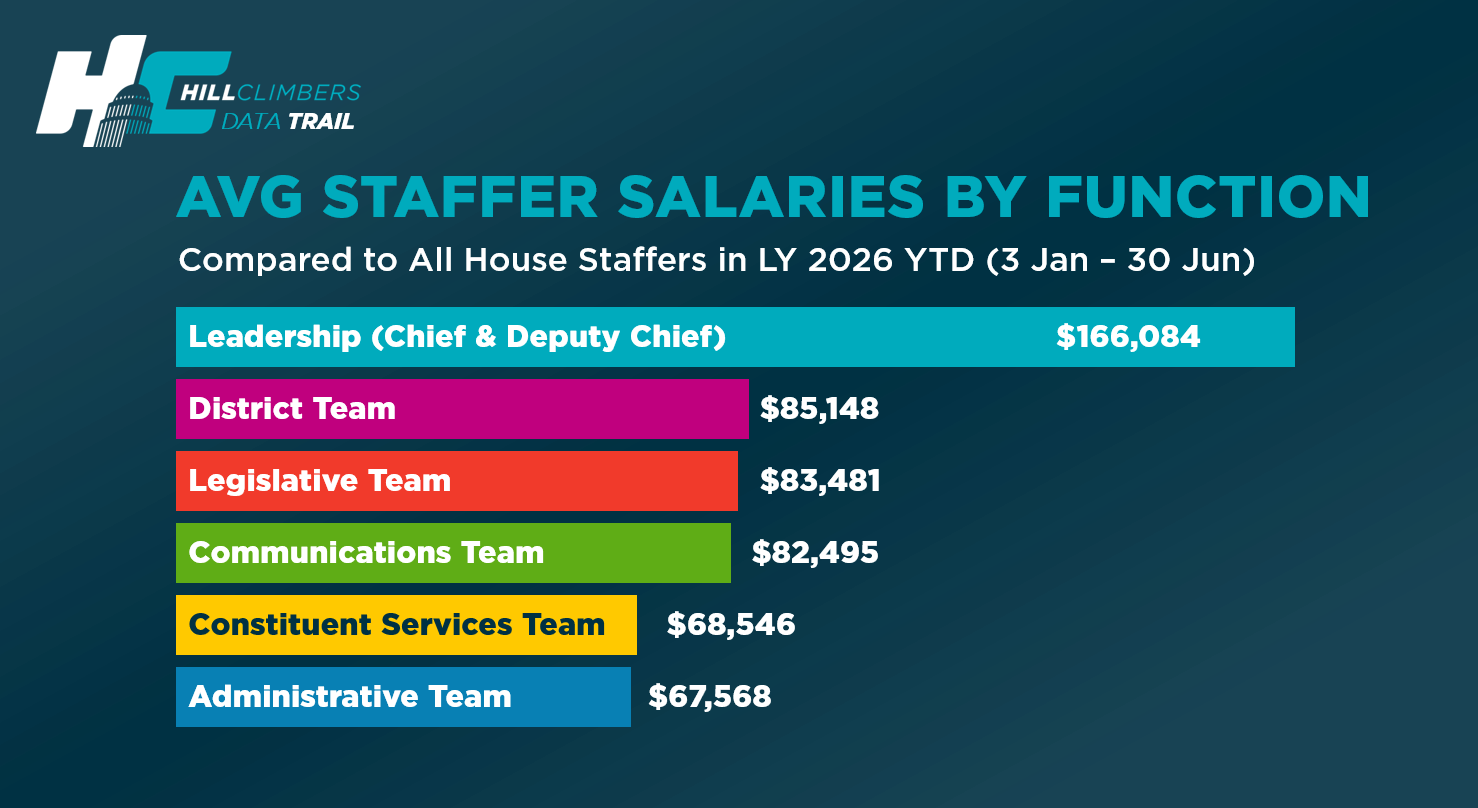
District staff averaged $85,148.
All House Staff excluding interns averaged $82,006.
That puts the district function $3,142, or 3.8%, above the House-wide permanent-staff average.
It also leaves district ahead of legislative staff at $83,481 and communications staff at $82,495.
But the new HillClimbers methodology lets us ask a cleaner question than the earlier analysis did:
What happens when we remove the person running each functional team?
For district staff, the answer is significant.
Remove the District Director and the average falls to:
$70,514.
That is $1,310 below the $71,824 average for all non-leader House staff.
District is the highest-paid House function overall. Below the District Director level, it is not.
That distinction is the most important update to the earlier district salary finding.
District Directors Have a Large Effect on the Team Average
The gap between the full district average and the non-leader district average is $14,634.
That does not mean the average District Director earns $14,634 more than other district employees. These are two different workforce averages.
But it does show how substantially the functional-leader layer affects the district team's overall compensation profile.
The district function includes three primary role groups:
District Directors, who manage the Member's district operation.
Deputy District Directors, who help manage district operations, staff, outreach, and constituent-facing work.
Field Representatives, who serve as the Member's eyes and ears across communities, organizations, local governments, and stakeholder networks.
Those jobs sit on the same team.
They do not sit at the same organizational level.
That is why the full-team and non-leader averages tell such different stories.
District Staff Lead House Pay, but Non-Leaders Average $70,514

District Remains the Highest-Paid Full Function
Across the five major Member office functions, Q2 salaries were:
- District: $85,148
- Legislative: $83,481
- Communications: $82,495
- Constituent Services: $68,546
- Administrative: $67,568
District remains at the top.
That continues the broad pattern HillClimbers identified in the previous district salary analysis, when district staff also led the functional comparison.
But the updated methodology changes how we should interpret that ranking.
The earlier analysis grouped functional leaders with the rest of their teams while comparing those teams against a broader non-leadership benchmark.
This series now separates the functional leaders so every team can be compared on the same basis.
That matters especially for district staff.
District Staff Have the Highest Full-Team Salary Average
The $85,148 figure remains useful.
It tells us what the district function looks like as a whole.
But it should not be interpreted as what a typical Field Representative or Deputy District Director makes.
For that, the non-leader comparison is more revealing.
Below the District Director Level, District Moves to Second
For this updated five-part salary series, HillClimbers uses one common definition of a non-leader staffer.
Chiefs and Deputy Chiefs are removed.
Each team's functional leader is removed.
Interns, temporary employees, and part-time employees are excluded.
For the district team, the functional leader is the District Director.
That leaves Deputy District Directors and Field Representatives within the non-leader district benchmark.
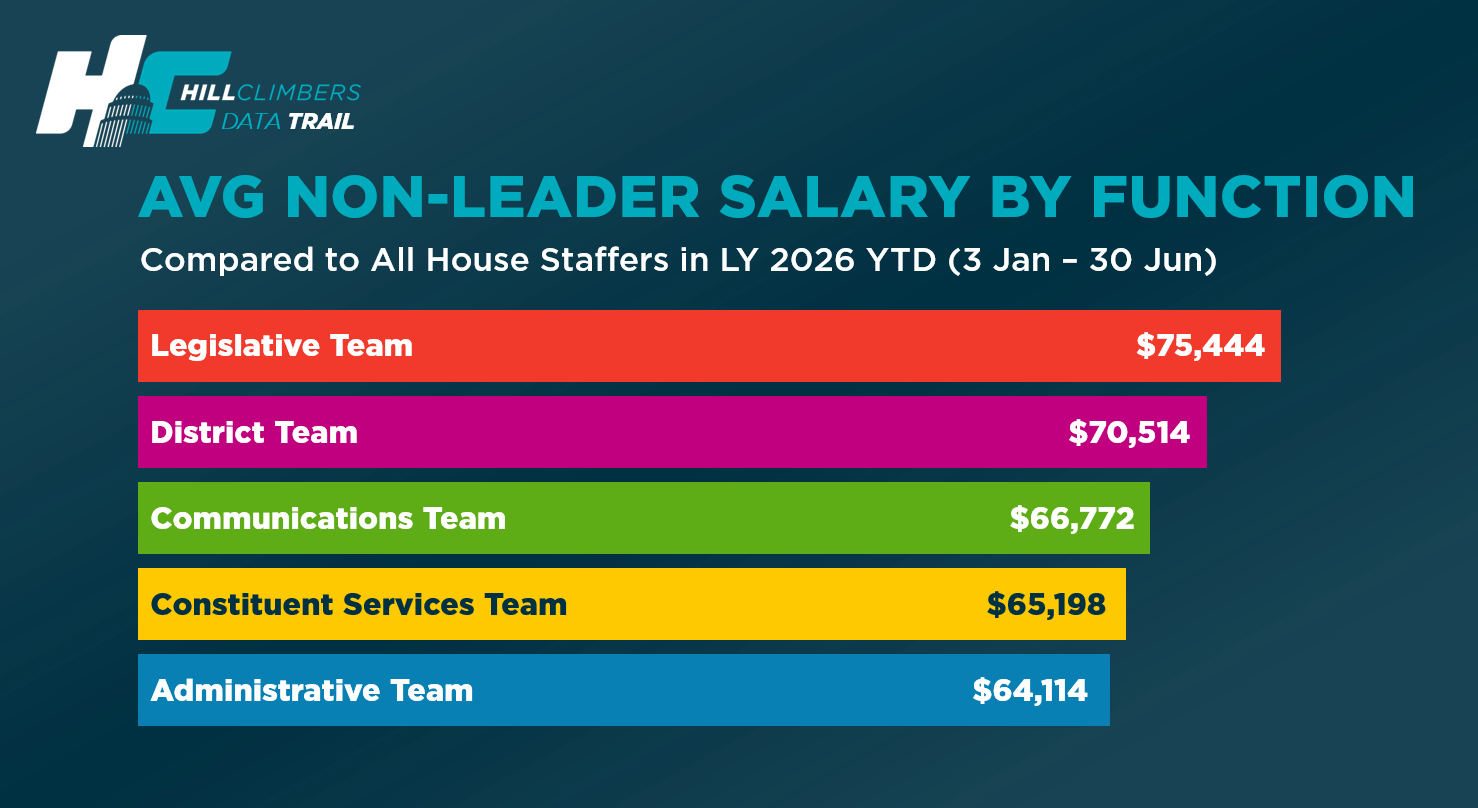
Across the five functions:
- Legislative: $75,444
- District: $70,514
- Communications: $66,772
- Constituent Services: $65,198
- Administrative: $64,114
District drops from first overall to second among non-leader functions.
And unlike the full-team figure, its $70,514 average is actually 1.8% below the $71,824 All Non-Leader Staff benchmark.
It is also:
$4,930 below legislative staff
$3,742 above communications
$5,316 above constituent services
$6,400 above administrative staff
Remove District Directors and District Pay Falls to $70,514
The conclusion is more nuanced than the earlier article.
District remains the highest-paid full functional team.
But the people working below the District Director level do not sit above the House-wide non-leader average.
The district pay premium is much more concentrated at the top of the team than the full-team average suggests.
District Staff Bring a Lot of House Experience
Pay is only one reason the district workforce stands out.
Experience may be the bigger story.
Through June 30, 2026:
District Directors averaged 6.7 years of House experience.
Deputy District Directors averaged 6.4 years.
Field Representatives averaged 3.7 years.
The senior district operation is therefore not made up primarily of employees who arrived on the Hill recently.
District Directors and Deputies, on average, have spent more than six years inside House or Member-office environments.
That experience matters differently in a district office than it does in Washington.
A veteran district employee develops knowledge of local governments, businesses, civic organizations, advocacy groups, federal facilities, community leaders, geographic differences inside the district, recurring constituent concerns, and the history of the Member's relationships across those communities.
Much of that knowledge is relational.
It cannot be reconstructed from an office manual.
HillClimbers has previously found that institutional knowledge in Congress is increasingly held by staff.
District offices offer a particularly tangible example.
Their institutional knowledge is also local knowledge.
District Directors Are a Very Experienced Workforce
The District Director numbers stand out.
The House averaged 394 District Director role positions per day during the first half of 2026.
Across that period, 423 people held the role.
They averaged 6.7 years of House experience.
Only 6.3% carried multiple classified roles.
And through June 30, role turnover had reached 7.4%.
That turnover figure is a first-half checkpoint, not a final annual rate.
Role turnover accumulates as the year progresses, so the 7.4% figure will not represent the final 2026 result.
Still, the combination of experience and relatively limited movement through the first six months suggests a senior district workforce with substantial continuity.
District Directors are also unusual because their knowledge extends beyond internal House operations.
They often manage relationships that have taken years to build outside Congress itself.
A new District Director can learn the organizational chart.
Rebuilding years of community relationships takes longer.
Deputy District Directors Look Nearly as Experienced
Deputy District Directors show a similar experience profile.
The House averaged 138 Deputy District Director role positions per day through June 30.
161 people held the role at some point during the period.
Their average House experience was 6.4 years, only slightly below District Directors.
First-half role turnover had reached 16.6%.
And 5.1% held multiple classified roles.
That suggests the deputy level is not simply a junior district-management position.
On average, these employees already bring substantial congressional experience.
That matters for succession too.
When experienced Deputies move into District Director positions, Congress may retain years of institutional and local knowledge even though the employee technically turns over from the deputy role.
This is one reason role turnover requires careful interpretation.
Field Representatives Are the Backbone of the District Workforce
By volume, Field Representatives are the largest district role group.
The House averaged 782 Field Representative role positions per day during the first half of 2026.
Across the period, 924 people held the role.
They averaged 3.7 years of House experience.
That is considerably less than the senior district leadership layer, but it is still a meaningful amount of congressional experience for a role that often serves as the office's direct connection to communities across the district.
Field Representatives attend community meetings.
They work with local elected officials.
They maintain stakeholder relationships.
They represent the Member at events.
They surface local concerns.
And in geographically large districts, they may be the office's primary presence across entire regions.
The role is often where national representation becomes local representation.
Field Representatives Are Also Much More Likely to Wear Multiple Hats
Multiple-role staffing looks very different across the district hierarchy.
Among District Directors, 6.3% hold multiple roles.
Among Deputy District Directors, the share is 5.1%.
Among Field Representatives:
16.6% hold multiple roles.
That is more than twice the rate of either district-management group.
Field Representatives' most common additional roles include Constituent Services Representative/Caseworker, Communications Staff, and Staff Assistant.
That combination makes operational sense.
District outreach frequently intersects with casework.
Community events intersect with communications.
Small district offices may need someone to support front-office or administrative responsibilities as well.
But it also illustrates why headcount alone does not tell us how district work is distributed.
One Field Representative can appear as one person in an office while covering responsibilities across several functions.
HillClimbers' broader multiple-role staffing analysis found that 8.2% of Member office staff held multiple roles in 2026.
The 16.6% Field Representative rate is roughly twice that broader share, although the measures come from different analytical views. The House-wide figure is office-view and person-level, while these district figures examine the people occupying a particular classified role.
The direction is still useful.
Multiple-role work is much more concentrated among Field Representatives than among the people managing the district operation.
The district hierarchy gets less experienced and more multi-role as you move closer to the field level.
District Role Turnover Is Already Measurable, but These Are Not Full-Year Rates
Through June 30, role turnover had reached:
7.4% for District Directors
16.6% for Deputy District Directors
18.0% for Field Representatives
Those numbers will rise as more role changes occur during the second half of the year.
They should therefore be treated as Q2 checkpoints, not final 2026 turnover rates.
There is another important limitation.
This is role turnover, not office turnover and not House departure turnover.
A Field Representative who becomes a Deputy District Director counts as turnover from the Field Representative role.
A Deputy District Director who becomes a District Director counts as turnover from the deputy role.
Someone who leaves the House entirely also counts as turnover.
But someone who moves from one Member office to another and remains a Field Representative does not count as role turnover.
That makes these measures fundamentally different from the office-based stability measures used in the HillClimbers Index.
The role data asks:
How quickly are people moving out of this job?
The office view asks:
How stable is this Member's workforce?
Both matter, but they answer different questions.
Some District Turnover May Be the Career Ladder Working
That distinction is particularly important for district roles.
A Field Representative who becomes a Deputy District Director has turned over from one role.
But Congress has not lost the employee.
It has promoted them.
The same can happen when a Deputy becomes a District Director.
That movement can be a sign of a functioning career ladder rather than a workforce failure.
The experience numbers suggest why that pipeline matters.
A person reaching the District Director or Deputy District Director level brings, on average, more than six years of House experience.
That experience had to come from somewhere.
Field Representative, casework, communications, legislative, and other Member-office roles can all contribute to the professional development that eventually produces experienced district leadership.
The institutional goal is not zero role turnover.
It is preserving enough of the experience behind that turnover inside Congress.
District Offices Hold a Different Kind of Institutional Memory
HillClimbers has written extensively about congressional institutional memory.
Much of that discussion naturally centers on legislative procedure, policy expertise, committee work, and House operations.
District staff hold another kind.
They know the district.
They know which local leaders have worked with the office for years.
They know which communities have historically struggled to access federal services.
They know the geography.
They know which agencies, nonprofits, businesses, schools, hospitals, military installations, and local governments repeatedly interact with the office.
They know how a national policy issue actually lands locally.
That knowledge matters to the Member's legislative staff too.
District staff can tell Washington what communities are experiencing before those problems become national statistics.
They can identify implementation failures.
They can surface emerging issues.
They can tell the office when a federal program is not working as intended on the ground.
This is one reason congressional capacity is staff capacity.
The capacity of a Member office does not end at the Capitol.
The District Team Also Connects Several Office Functions
The multiple-role data helps illustrate something else.
A district office is not operationally isolated from the rest of the Member office.
Field Representatives commonly overlap with casework and communications.
Deputy District Directors can overlap with constituent services management, scheduling, and other senior responsibilities.
District Directors sometimes carry Deputy Chief of Staff or other senior-office responsibilities.
That makes district operations part of a larger organizational system.
Outreach can generate casework.
Casework can reveal policy problems.
Local events create communications opportunities.
Stakeholder conversations can inform legislation.
District feedback can shape what Washington staff prioritize.
Headcount by function helps us understand office structure.
But the boundaries between those functions are often porous.
Higher Full-Team Pay May Help Preserve District Experience
The district team occupies an unusual position in this salary series.
Its full-team average is the highest of the five functions.
Its senior roles are also among the most experienced workforces examined in the series so far.
Those two facts may be related, but this analysis does not establish that higher district pay causes greater experience or lower turnover.
Many other factors matter.
District labor markets vary dramatically by geography.
Senior district jobs can carry substantial management responsibilities.
Staff may have deep ties to the communities they serve.
Career opportunities outside Washington differ from those available to D.C.-based policy or communications employees.
And role turnover includes internal advancement, not simply departures.
Still, compensation is part of the workforce environment.
HillClimbers has previously found that lower-paying Member offices tend to experience higher turnover.
For district operations, where local relationships and knowledge often compound over years, the ability to retain experienced employees can have direct consequences for office capacity.
Flat Budgets Still Put Pressure on the Model
District staff may lead the functional salary comparison, but they operate under the same budget constraint as everyone else.
Every Member office funds its workforce through the Member Representational Allowance.
That same budget has to support Washington staff, district staff, travel, rent, technology, communications, supplies, and other operating costs.
HillClimbers' recent staffing research has shown what happens when that budget stops growing.
House staffing expanded when office resources increased.
As budgets flattened, staffing began to fall again.
The Q2 2026 staffing update found Member offices averaging 6,827 non-intern staff per day, down from the 2024 rebound.
That creates a challenge for district teams.
Experienced District Directors cost more to retain.
Deputy District Directors bring more than six years of House experience on average.
Field Representatives provide much of the office's geographic reach.
And some Field Representatives are already covering multiple functions.
A flat nominal budget does not make those responsibilities disappear.
It narrows the room an office has to pay for them.
Why the New $85,148 Figure Should Not Be Compared Directly With $88,184
The earlier HillClimbers district salary article reported a $88,184 district team average using LY 2025 YTD data.
The updated Q2 2026 figure is $85,148.
That should not be described as a clean $3,036 salary decline.
HillClimbers has revised the methodology underlying the updated series.
House-wide measures now use the revised person-level approach introduced in the 2026 staffing analysis.
The non-leader comparison has also been standardized.
The earlier analysis compared district staff with non-district, non-leadership employees.
The new series instead creates one common All Non-Leader Staff benchmark across all five functions.
It:
- classifies Chiefs and Deputy Chiefs as leadership
- removes the functional leader of each major team
- excludes interns, part-time employees, and temporary employees
- keeps the team being analyzed inside the common non-leader benchmark
That gives all five articles the same $71,824 comparison point.
The new figures should therefore become the benchmark going forward.
The New Data Complicates the Old Headline in a Useful Way
The prior article said district staff were the highest-paid non-leadership team.
That was accurate under the methodology used at the time.
The updated data lets us be more precise.
District is the highest-paid full functional team.
But once District Directors are treated consistently with the functional leaders of legislative, communications, constituent services, and administrative teams, non-leader district staff average $70,514.
That is second among the five functions.
And it is slightly below the House-wide non-leader average.
The more interesting finding may be what accompanies that salary structure.
District Directors average 6.7 years of House experience.
Deputies average 6.4 years.
Field Representatives average 3.7 years.
Role turnover through the first half remains much lower among District Directors than among the more junior district roles.
And Field Representatives are considerably more likely to carry multiple jobs.
Those numbers describe a district workforce with a deeply experienced leadership layer and a much larger field operation underneath it.
That structure is what keeps a Member connected to the place they represent.
District capacity is not simply having offices outside Washington. It is having experienced people who know the communities inside them.
This Is the Fourth Update in the Five-Part Q2 Salary Series
The district analysis follows HillClimbers' updated looks at the legislative team, constituent services team, and communications team.
One team remains:
Administrative staff.
After that article, HillClimbers can bring all five functions together into a broader look at how pay, experience, turnover, multiple-role staffing, and workforce structure differ across the modern House Member office.
FAQ
How much do House district staff make in 2026?
The full House district team averaged $85,148 through June 30, 2026. District staff below the District Director level averaged $70,514.
Are district staff the highest-paid House functional team?
Yes, when the full function is included. District staff averaged $85,148, ahead of legislative staff at $83,481 and communications staff at $82,495. Once functional leaders are removed, legislative staff rank first and district staff rank second.
Why does district pay fall so much when District Directors are removed?
District Directors are the senior functional leaders of district operations. Removing that leadership layer reduces the district average from $85,148 to $70,514. The $14,634 difference between those two averages should not be interpreted as the average District Director salary.
How much do non-leader district staff make?
Deputy District Directors and Field Representatives within the non-leader district population averaged $70,514, compared with $71,824 for all non-leader House staff.
How experienced are House District Directors?
District Directors averaged 6.7 years of House experience through June 30, 2026.
How experienced are Deputy District Directors?
Deputy District Directors averaged 6.4 years of House experience.
How experienced are Field Representatives?
Field Representatives averaged 3.7 years of House experience.
How many District Directors are there?
The House averaged 394 District Director role positions per day during the first half of 2026. Across the period, 423 people held the role.
How many Deputy District Directors are there?
The House averaged 138 Deputy District Director role positions per day, while 161 people held the role during the period.
How many Field Representatives are there?
The House averaged 782 Field Representative role positions per day during the first half of 2026. 924 people held the role at some point during the period.
What is turnover among House district staff?
Through June 30, role turnover had reached 7.4% for District Directors, 16.6% for Deputy District Directors, and 18.0% for Field Representatives. These are first-half checkpoints, not final 2026 rates.
Does role turnover mean someone left Congress?
Not necessarily. Role turnover occurs when someone stops holding a classified role. That can include promotion or another role change inside the House as well as departure from Congress. Someone who changes offices but remains in the same classified role does not count as role turnover.
How many district staff carry multiple roles?
Multiple-role shares were 6.3% for District Directors, 5.1% for Deputy District Directors, and 16.6% for Field Representatives.
What other roles do Field Representatives commonly perform?
Common secondary roles include Constituent Services Representative/Caseworker, Communications Staff, and Staff Assistant.
Where can I find congressional district jobs?
Current openings are available on the HillClimbers Congressional Jobs Board, with additional role information on the District Director, Deputy District Director, and Field Representative pages.
Suggested Reading
- House District Staff Are the Highest-Paid Non-Leadership Team
- The Staff Helping Shape the Nation's Laws Average $75,444
- The Comms Team Is Growing, but Non-Leader Pay Averages Just $66,772
- House Constituent Services Staff Salary: $65,198
- Institutional Knowledge in Congress Is Increasingly Held by Staff
- More House Staff Are Wearing Multiple Hats
- Congressional Staffing Levels Rise Or Fall Based On How Much Congress Invests In Itself
- The House Staffing Drop Is No Longer Just an Early-Year Dip
Explore Related HillClimbers Tools
- District Director
- Deputy District Director
- Field Representative
- Explore Member Office Roles
- Explore All House Staff Excluding Interns
- Explore Congressional Staffing Data
- Learn How Congressional Staffing Works
- Explore the HillClimbers Index
- View Current Congressional Jobs