
HillClimbers Saw This Shift Coming
Congressional internships used to have a clear seasonal rhythm.
Summer was the main event. Spring and fall mattered, but they were usually smaller. Offices brought in students during academic breaks, saw intern counts rise sharply in the summer, then watched them fall again as interns returned to school.
HillClimbers warned in 2025 that this model was changing.
In Congressional Intern Staffing Now Stays Elevated Year-Round, HillClimbers showed that intern staffing was no longer collapsing after the summer cycle in the way it once did. In When Interns Become Infrastructure, HillClimbers argued that interns were becoming a recurring operational layer inside House offices, not just a temporary educational supplement.
The latest 2026 data strengthens that interpretation.
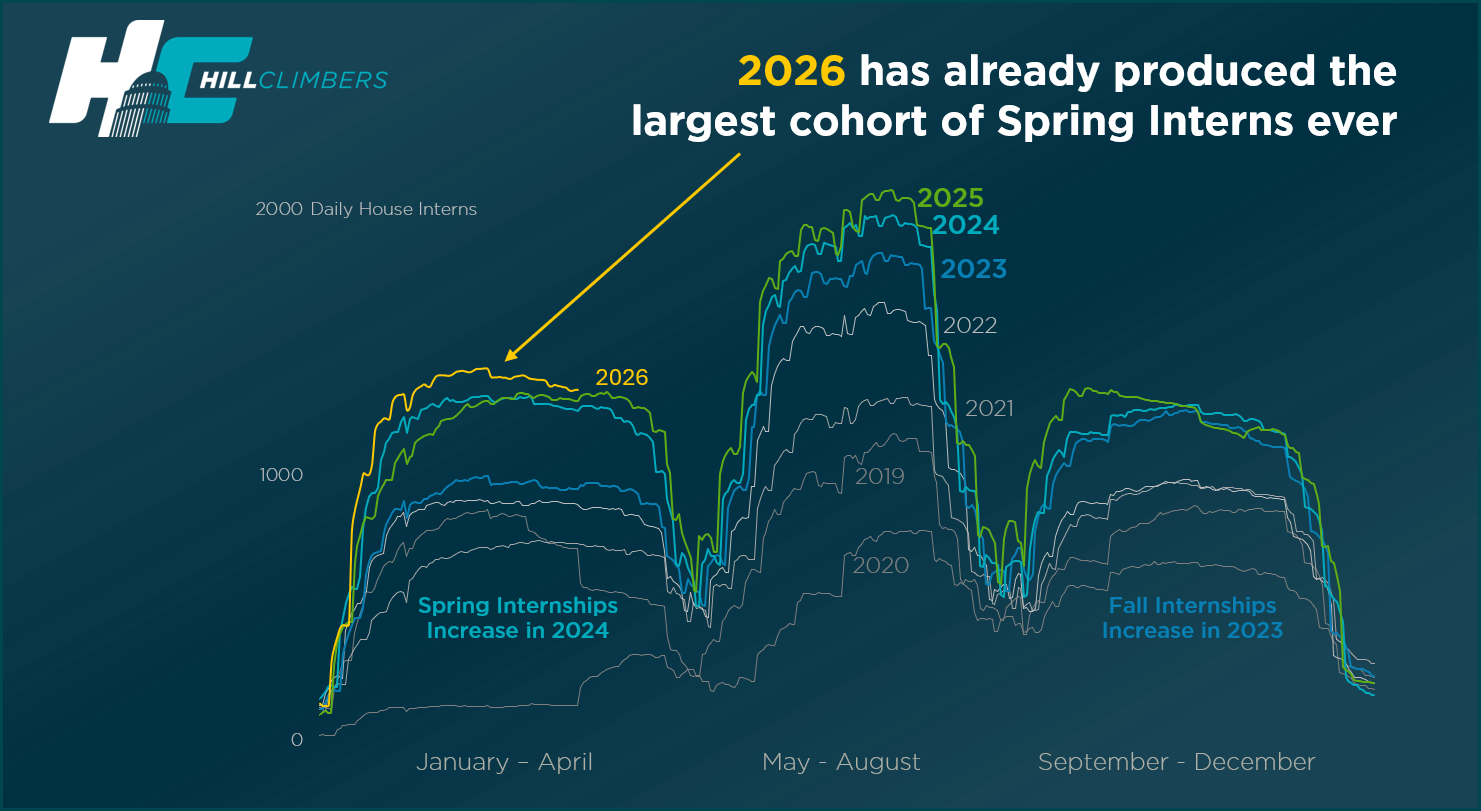
HillClimbers’ daily House intern staffing data now shows that 2026 has already produced the largest spring intern cohort in the dataset. The spring internship cycle is no longer just a smaller lead-in to summer. It is becoming a major staffing period of its own.
Spring internships are no longer just the warm-up act before summer.
The new data does not just show that internships are still expanding. It shows the expansion is moving earlier in the year.
2026 Has Already Produced the Largest Spring Intern Cohort Ever
Summer Still Leads, But Spring Is Catching Up
Summer remains the largest internship season in House offices.
That is still visible in the data. The May-to-August period continues to produce the highest internship levels, with recent summer cohorts far above earlier years. The 2023, 2024, and 2025 summer lines show how much larger the congressional internship system has become since the paid-intern expansion and the post-2021 staffing changes.
But the spring shift is the newer story.
The 2026 line rises earlier and higher than prior spring cohorts. It does not wait for summer to show the internship expansion. By the January-to-April period, House offices are already carrying intern staffing levels that would have looked unusual in earlier years.
That means the congressional internship calendar is changing in two ways at once:
- summer remains large
- spring is becoming much larger than it used to be
The result is a more continuous internship model. Offices are not simply bringing in a summer wave. They are increasingly maintaining meaningful intern capacity before summer begins.
The 2026 Data Reinforces the “Interns as Infrastructure” Pattern
This new finding fits directly into HillClimbers’ broader special report, When Interns Become Infrastructure.
That report argued that interns are no longer just a temporary educational supplement. They are increasingly becoming a major workforce group inside House offices.
The 2026 spring data strengthens that interpretation.
If internships were still mainly a summer educational experience, the largest changes would be concentrated in May through August. Instead, the data shows the spring period itself expanding. That suggests offices are relying on interns earlier in the year and across more of the operating calendar.
The internship system is not just getting bigger. It is getting more continuous.
That distinction matters. A bigger summer program is a seasonal expansion. A larger spring cohort is a staffing-structure change.
Why Offices May Be Leaning More on Spring Interns
The data does not prove why every office is expanding spring internships. But the broader staffing context makes the trend understandable.
House offices face rising workload pressure, flat budgets, and increasingly difficult staffing tradeoffs. HillClimbers recently found that flat budgets do not mean flat staffing levels. House staffing excluding interns declined from the beginning of February to the end of March in the second session of the 119th Congress.
HillClimbers also found that House offices are running out of things to cut, with 2026 Q1 spending falling across both personnel and non-personnel categories.
Those budget and staffing pressures create incentives for offices to find flexible support.
Interns can help with recurring work that does not disappear when budgets tighten:
- constituent correspondence
- front office coverage
- legislative research
- hearing and briefing support
- social media and digital tasks
- scheduling assistance
- district office support
- administrative operations
That does not mean interns are replacing permanent staff one-for-one. The data does not prove that. But it does suggest that recurring intern cohorts are becoming part of how offices manage workload pressure.
Spring Internships Now Matter More for Career Pathways
For students and early-career applicants, the 2026 spring data changes the practical career picture.
The old advice treated summer as the central congressional internship window. That is still partly true. Summer remains the largest season and will continue to attract many applicants.
But spring now matters much more than it used to.
HillClimbers’ guide on when to apply for congressional internships already showed that internship hiring is becoming more year-round. The 2026 spring data gives that advice more weight. Applicants who only focus on summer may miss an increasingly important part of the congressional internship market.
A larger spring cohort also means more offices may be using internships as recurring talent pipelines. For students, spring internships can provide earlier exposure to Capitol Hill work. For offices, spring cohorts can create a pool of trained interns before summer and potentially before later entry-level hiring decisions.
That matters because HillClimbers has separately shown that freshman congressional offices may offer strong entry points into Capitol Hill careers. Internships remain one of the clearest paths into those early-career opportunities.
Students and job seekers can also track current Hill openings through the HillClimbers congressional jobs board, which includes House, Senate, and Hill-adjacent roles.
Intern Growth Raises a Workforce Question
The growth of spring internships is not automatically good or bad. It depends on what the internship model is becoming.
If larger spring cohorts mean more students and young professionals receive paid access to congressional experience, that is a meaningful benefit. Congress should have more accessible pathways into public service.
But if offices increasingly depend on rotating interns to absorb work that permanent staff used to handle, the workforce implications are more complicated.
HillClimbers has already shown that Congress quietly replaced part of its entry-level workforce. That trend matters here because internships and entry-level staff roles sit near the same workforce pipeline.
A healthy congressional workforce needs both:
- accessible internships that introduce people to public service
- stable entry-level jobs that turn early experience into paid career pathways
If internships grow while permanent entry-level roles shrink, Congress may be expanding access at the front door while narrowing the path beyond it.
That is the structural concern.
The Spring Surge Also Changes Office Operations
A larger spring intern cohort changes how offices operate.
Every semester-based internship model requires recurring recruitment, onboarding, supervision, and training. As internship staffing becomes more continuous, offices must repeatedly transfer knowledge to temporary workers.
That can help offices manage workload, but it also creates operational churn.
Permanent staff still carry the institutional memory. A Staff Assistant, Legislative Correspondent/Aide, Scheduler, or Constituent Services Representative/Caseworker may be responsible for supervising or coordinating work that interns help support.
That is why intern growth should not be viewed separately from permanent staff capacity.
HillClimbers’ Member Office Roles page shows how different office functions fit together. Interns can support those functions, but they do not replace the need for experienced staff who understand the office, the district, the Member, and the institution.
Paid Interns Are Now a Workforce Signal
The Paid Intern role has become one of the most important workforce signals in congressional staffing data.
That would have sounded odd a decade ago. Interns were visible, but they were not usually treated as a central indicator of office capacity.
That has changed.
HillClimbers has already found that paid congressional intern staffing is rising while average stipends are falling. The 2026 spring data adds another layer: the expansion is not just about how many interns Congress uses in summer. It is about how early and how consistently offices are using interns throughout the year.
For workforce analytics, that makes intern staffing a leading indicator.
When intern counts rise during spring, it may signal that offices are seeking capacity before the traditional summer surge. When spring, summer, and fall levels all remain elevated, it suggests the internship model is becoming a year-round operating layer.
Why This Matters for Congressional Staffing
Congressional internships are often discussed as career opportunities. They are that, but the data now suggests they are also becoming a staffing signal.
House offices operate within staffing caps, MRA limits, district demands, legislative workloads, communications pressure, and constituent-service needs. HillClimbers’ explainer on how congressional staffing works shows how those constraints shape the modern Member office.
The 2026 spring intern surge should be read against that backdrop.
If offices are adding more spring interns, it may mean they are expanding educational access. It may also mean they are trying to manage more work with more flexible labor. Those are not mutually exclusive.
That is why HillClimbers tracks interns as part of the broader congressional workforce, not as a side category.
The internship system is now connected to questions about staffing, salaries, turnover, office capacity, and early-career pathways.
What the 2026 Spring Data Shows
The clearest finding is simple: 2026 has already produced the largest spring intern cohort in HillClimbers’ daily House intern staffing data.
That is not just a seasonal footnote.
It means the internship expansion is continuing into the part of the year that used to be smaller. It means offices are carrying more intern capacity before summer. It means the year-round internship model is becoming more visible.
The 2026 spring surge also fits the broader congressional workforce picture. House offices are facing budget pressure, staffing pressure, salary pressure, and workload pressure. Interns appear to be one way offices are managing that environment.
That does not make internships less valuable. It makes them more important to understand.
Congressional internships still offer students and early-career professionals a critical entry point into public service. But the data suggests they are also becoming something more: a recurring operational layer inside House offices.
When interns become part of the infrastructure, internship policy becomes workforce policy.
That shift should be tracked carefully.
Because when interns become part of the infrastructure, internship policy becomes workforce policy.
FAQ
Are congressional internships becoming year-round?
Yes. HillClimbers’ daily House intern staffing data shows congressional internships increasingly remain elevated across more of the calendar year. The 2026 spring data strengthens that finding because spring intern staffing has already reached the highest spring level in the dataset.
Is summer still the biggest congressional internship season?
Yes. Summer remains the largest congressional internship season. The key change is that spring and fall are no longer minor periods in the same way they once were. The 2026 spring cohort is especially notable because it rose above prior spring levels before the summer internship peak.
What does the 2026 spring intern data show?
The 2026 data shows that House offices have already produced the largest spring intern cohort in HillClimbers’ daily intern staffing data. That suggests the internship expansion is not limited to summer and that spring internships are becoming a more important part of congressional office staffing.
Did HillClimbers expect congressional internships to become more year-round?
Yes. HillClimbers previously identified the shift toward elevated year-round intern staffing and argued that interns were becoming a recurring operational layer inside House offices. The 2026 spring data strengthens that earlier finding by showing the largest spring intern cohort in the daily House data.
Why are House offices using more interns in spring?
The data does not prove a single cause, but several pressures likely matter. House offices face large workloads, flat budgets, and staffing constraints. Recurring intern cohorts can provide flexible support for constituent correspondence, front office coverage, legislative research, communications, scheduling, and administrative work.
Are interns replacing permanent congressional staff?
The data does not prove direct replacement. But HillClimbers’ broader workforce analysis suggests internships are becoming a larger and more persistent layer of House office staffing while some traditional entry-level roles have declined. That raises important questions about the relationship between internships, permanent staff capacity, and career pathways.
When should students apply for congressional internships?
Students should no longer think only in terms of summer. Summer remains important, but spring and fall opportunities are increasingly significant. HillClimbers’ guide to congressional internship hiring cycles explains how applicants should think about timing across the year.
What do congressional interns do?
Modern congressional interns may support constituent correspondence, front office coverage, legislative research, hearing preparation, scheduling support, digital communications, social media, district office work, and administrative operations. Duties vary by office, semester, and location.
Why does spring intern growth matter?
Spring intern growth matters because it shows internships are becoming more continuous. A large summer cohort is seasonal. A record spring cohort suggests offices are embedding interns into regular operations across more of the year.
Suggested Reading
- Congressional Intern Staffing Now Stays Elevated Year-Round
- When Interns Become Infrastructure
- When to Apply for Congressional Internships
- Paid Congressional Intern Staffing Is Rising While Average Stipends Are Falling
- How Congress Quietly Replaced Part of Its Entry-Level Workforce