
House Administrative Staff Averaged $70,991 in 2025
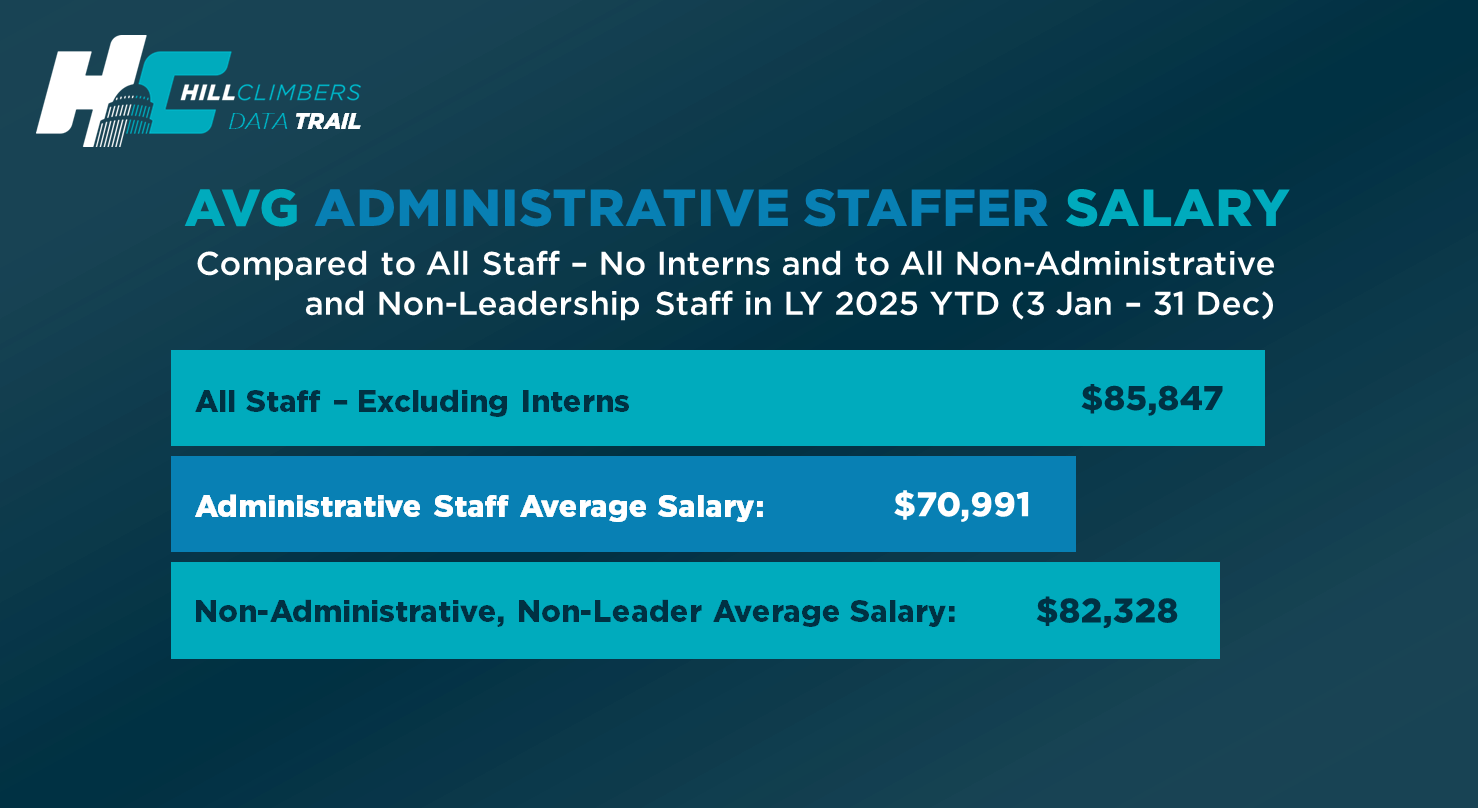
In LY 2025 YTD, the average House administrative team staffer made $70,991.
That is far below the average for All House Staff, Excluding Interns, which was $85,847.
The difference is $14,856.
But the more useful comparison removes both leadership staff and administrative staff from the benchmark group.
In this article, “peer staff” means non-administrative, non-leadership House staff.
That peer group averaged $82,328.
Administrative staff averaged $70,991.
That is an $11,337 gap.
The average House administrative team staffer made $70,991 in LY 2025 YTD.
Administrative Staff Salaries Sit Below Their Peer Average
Administrative Staff Are Not the Lowest-Paid Team, But They Are Close
The administrative team is near the bottom of the House staff team salary structure.
It is not the lowest.
In LY 2025 YTD, constituent services staff averaged $70,466, slightly below administrative staff at $70,991. The difference between those two teams was only $525.
That distinction matters. Administrative staff should not be described as the lowest-paid major team. The more accurate finding is that administrative staff sit near the bottom, just above constituent services.
The salary gap becomes more visible when administrative staff are compared with the rest of the non-leadership workforce.
Administrative staff averaged $11,337 less than non-administrative, non-leadership staff.
That does not prove that administrative staff are underpaid. It does show that administrative work occupies one of the lowest public compensation tiers among major House staff teams.
What the $70,991 Administrative Team Average Includes
The administrative team average includes several different roles, not one job title.
HillClimbers groups the House administrative team around these core roles:
- Director of Operations
- Executive Assistant/Office Manager
- Scheduler
- Administrative Staff
- Staff Assistant
A Director of Operations usually manages office systems, internal processes, and operational coordination. An Executive Assistant/Office Manager may support the Member, senior staff, office logistics, and internal workflow. A Scheduler manages one of the most time-sensitive functions in a congressional office. Administrative Staff and Staff Assistants often handle front-office operations, constituent intake, visitor support, mail, phones, logistics, and early-career office support.
Those roles belong to the same team, but they are not the same job.
That distinction matters for salary searches. The $70,991 figure is a public administrative team benchmark. It is not the exact salary for every Director of Operations, Executive Assistant, Office Manager, Scheduler, Administrative Staffer, or Staff Assistant.
How Much Does a Congressional Staff Assistant Make?
The best public answer is this:
A Staff Assistant is part of the House administrative team, and the average House administrative team staffer made $70,991 in LY 2025 YTD.
That does not mean every Staff Assistant made $70,991.
The administrative team average includes more senior operational roles, such as Director of Operations, and more entry-level roles, such as Staff Assistant. A Staff Assistant should not be benchmarked against the team average without role-level context.
For public salary context, the administrative team average is useful.
For salary negotiation, role-level data matters.
The team average answers the public question. Role-level data answers the negotiation question.
Administrative Staff Make Less Than Most Other Non-Leadership Teams
The administrative team sits near the bottom of the 2025 team salary comparison.
In LY 2025 YTD:
- District staff averaged $88,184.
- Legislative staff averaged $86,020.
- Communications staff averaged $84,601.
- Administrative staff averaged $70,991.
- Constituent services staff averaged $70,466.
That team-by-team view is more useful than one broad average.
Administrative staff sit below district, legislative, and communications staff. They sit slightly above constituent services staff.
They are also $11,337 below the non-administrative, non-leadership peer average.
That ranking matters because administrative work is foundational to a congressional office. Administrative staff support scheduling, front-office flow, visitor operations, internal coordination, records, logistics, and office systems.
The operational effect is straightforward: the staff who help keep the office running sit near the bottom of the major team compensation structure.
Administrative Staffing Has Also Declined Since 2016
The salary story is not just about pay.
Administrative staffing has also declined over the long term.
In 2016, House administrative teams averaged 1,489.4 daily staff. By 2025, that figure had fallen to 1,275.5.
That is a decline of 213.9 average daily staff, or about 14%.
That shift is important because administrative work does not disappear when administrative staffing falls. Phones still ring. Visitors still arrive. Schedules still change. Events still need support. Internal systems still need coordination. The office still needs someone to absorb operational friction.
HillClimbers has written separately about administrative staff salary decline in Congress, and that article fits directly into this broader team-level salary series.
The workforce consequence is easy to miss. A smaller administrative footprint can push more operational work onto other staff, increase strain on entry-level employees, or make office systems more fragile.
Administrative staff are near the bottom of the salary structure while administrative staffing has also declined since 2016.
This Article Is Part of a Team-by-Team Salary Series
This administrative team article is one part of a broader HillClimbers salary series on House staff compensation by team.
The full series includes:
- House Legislative Staff Salary: $86,020 Average
- House Communications Staff Salary: $84,601 Average
- House District Staff Salary: $88,184 Average
- House Administrative Staff Salary: $70,991 Average
- House Constituent Services Staff Salary: $70,466 Average
Together, these team articles create a better public map of House staff compensation.
A single House-wide average tells readers what the entire workforce looks like. Team-level averages explain how compensation differs by office function. Role-level benchmarks explain what specific jobs are likely to pay.
That progression matters for job seekers, offices, researchers, and journalists.
Why Administrative Salary Searches Need Team-Level Context
Many people search by title.
They ask:
“How much does a congressional Staff Assistant make?”
“How much does a House Scheduler make?”
“What is a congressional Office Manager salary?”
“What does a Director of Operations make in Congress?”
Those are reasonable questions, but broad congressional salary averages often fail them.
The all-staff average may include interns, part-time employees, temporary staff, district staff, administrative staff, communications staff, constituent services staff, leadership staff, and legislative staff. That is too broad for someone evaluating an administrative job.
The All House Staff, Excluding Interns benchmark is better because it removes interns. But even that number still includes leadership salaries.
For administrative roles, the better public comparison is the administrative team average of $70,991.
For serious salary analysis, the next step is role-level data.
Why Role-Level Salary Data Still Matters
Team-level salary averages are useful. They are not enough.
A Director of Operations is usually a senior operational role. A Scheduler manages one of the office’s most demanding coordination functions. An Executive Assistant/Office Manager may support the Member, office systems, staff workflow, and daily operations. Administrative Staff and Staff Assistants often sit closer to front-office, intake, logistics, and early-career support work.
Those jobs sit on the same team, but they do not sit at the same level.
The same logic applies across the office. A Legislative Director is not the same as a Legislative Assistant. A Press Secretary/Communications Director is not the same as Communications Staff. A District Director is not the same as a Field Representative. A Director of Constituent Services/Casework is not the same as a Constituent Services Representative/Caseworker.
That is why the team average is a public benchmark, not a final answer.
For salary negotiation, hiring strategy, workforce research, or career planning, the right comparison is the specific role.
Administrative staff salaries should be compared to administrative roles, not the entire House workforce.
What This Means for Congressional Job Seekers
For job seekers, the $70,991 administrative team average is a useful anchor.
It tells you that House administrative staff, as a group, are far below the all-staff no-intern average and below most other major non-leadership teams.
That helps frame an administrative job search.
A job seeker should ask whether the position is a Director of Operations role, Scheduler role, Executive Assistant/Office Manager role, Administrative Staff role, Staff Assistant role, or a hybrid title. The difference matters.
The salary question should also account for the scope of the job. Does the role manage office operations? Does it control the Member’s schedule? Does it supervise staff? Does it handle front-office intake, logistics, visitor support, or internal systems? Does it require previous Hill experience? Is the position entry-level, mid-level, or senior?
Those details change the salary comparison.
Readers can review current openings through HillClimbers congressional jobs and the broader HillClimbers jobs board. The member office roles page can help readers understand how congressional jobs fit into the structure of a Member office.
What This Means for Congressional Offices
For Member offices, administrative salary data is not just a compensation issue.
It is an office capacity issue.
The administrative team helps the office function every day. It supports scheduling, reception, internal coordination, constituent intake, logistics, staff workflow, visitor experience, and operational continuity.
When administrative staff are experienced, stable, and well matched to their responsibilities, offices can function with less friction.
When administrative teams are thin, inexperienced, or unstable, small problems become office-wide problems.
That connects administrative salary analysis to broader HillClimbers research on congressional staffing budget pressure, House office size and staffing trends, entry-level congressional staff decline, and congressional institutional memory.
The institutional stakes are larger than the salary count. Pay affects retention, entry-level pipelines, office continuity, and the ability of congressional offices to manage daily operations.
Related HillClimbers Salary and Staffing Analysis
The administrative team salary average is one part of a larger congressional workforce picture.
For readers comparing administrative pay to broader congressional compensation, HillClimbers explains why the average House staff salary changes when interns are excluded. That article shows why denominator choices affect broad congressional salary averages.
Administrative salaries also connect to office capacity. HillClimbers has analyzed administrative staff salary decline in Congress, congressional staffing budget pressure, House office size and staffing trends, and new House Members having smaller teams.
The administrative team is also tied to institutional knowledge. When experienced staff leave, offices lose more than headcount. They lose procedural memory, scheduling judgment, constituent intake patterns, office norms, vendor knowledge, and internal workflow history. That is why HillClimbers also tracks congressional staff turnover in lower-paying offices, career opportunities in freshman congressional offices, and congressional staff experience as Member tenure changes.
For broader public staffing context, readers can start with HillClimbers’ congressional staffing salary and staffing data, staffing insights, congressional dataset, and the HillClimbers Index.
FAQ Section
How much do House administrative staff make?
In LY 2025 YTD, the average House administrative team staffer made $70,991. That figure is a team-level benchmark, not a precise salary for every administrative role. Administrative pay can vary by office, title, seniority, responsibilities, and whether the role supports operations, scheduling, office management, front-office intake, or entry-level administrative work.
What is the average congressional Staff Assistant salary?
A Staff Assistant is part of the House administrative team, where the average team salary was $70,991 in LY 2025 YTD. However, Staff Assistant is typically an entry-level or early-career administrative role and should not be evaluated only against the full administrative team average. A precise Staff Assistant benchmark requires role-level data.
Is $70,991 the average House Scheduler salary?
No. The $70,991 figure is the average salary for the House administrative team overall. It includes multiple administrative roles at different levels, including Director of Operations, Executive Assistant/Office Manager, Scheduler, Administrative Staff, and Staff Assistant. A precise Scheduler salary benchmark requires role-level data.
How does administrative staff pay compare to the average House staff salary?
House administrative staff averaged $70,991 in LY 2025 YTD. All House staff excluding interns averaged $85,847, so the administrative team average was $14,856 lower than the permanent staff average. Compared with non-administrative, non-leadership staff, administrative staff averaged $11,337 lower.
Are administrative staff the lowest-paid House staff team?
No. Administrative staff were not the lowest-paid major non-leadership team in the LY 2025 YTD comparison. Administrative staff averaged $70,991, while constituent services staff averaged $70,466. Administrative staff were the second-lowest-paid major non-leadership team, just $525 above constituent services.
How does administrative staff pay compare to other House staff teams?
In LY 2025 YTD, district staff averaged $88,184, legislative staff averaged $86,020, communications staff averaged $84,601, administrative staff averaged $70,991, and constituent services staff averaged $70,466. Administrative staff sit below district, legislative, and communications staff, but slightly above constituent services staff.
What roles are included in the House administrative team?
HillClimbers’ House administrative team includes Directors of Operations, Executive Assistants/Office Managers, Schedulers, Administrative Staff, and Staff Assistants. These roles support office operations, scheduling, front-office workflow, logistics, and internal coordination.
Why are administrative staff salaries lower than many other teams?
Administrative staff salaries may sit lower because the team includes a large number of entry-level and early-career roles, including Staff Assistants and other front-office support positions. The data does not prove causation, but it shows that administrative staff occupy one of the lowest public compensation tiers among major non-leadership teams.
Where can I find current congressional administrative jobs?
Readers can review current openings on HillClimbers congressional jobs and the broader HillClimbers jobs board. HillClimbers role-summary pages also provide public context on congressional job titles, responsibilities, and how each role fits into a Member office.
Where can readers explore congressional salary data?
Readers can start with HillClimbers’ public congressional staffing page, staffing insights, and role summary pages. For role-specific salary benchmarks, workforce trends, career paths, and office-level insights, readers can use the HillClimbers Index or review HillClimbers plans.
Suggested Reading
- Average House Staff Salary Without Interns
- House Legislative Staff Salary: $86,020 Average
- House Communications Staff Salary: $84,601 Average
- House District Staff Salary: $88,184 Average
- House Constituent Services Staff Salary: $70,466 Average
- Administrative Staff Salary Decline in Congress
- Congressional Staffing Budget Pressure
- House Office Size and Staffing Trends
- Congressional Entry-Level Staff Decline
- Congressional Institutional Memory