
The 2,000-Intern Barrier Did Not Fall Until 2025
For years, even the largest congressional internship season stayed below one notable threshold.
Then summer 2025 broke it.
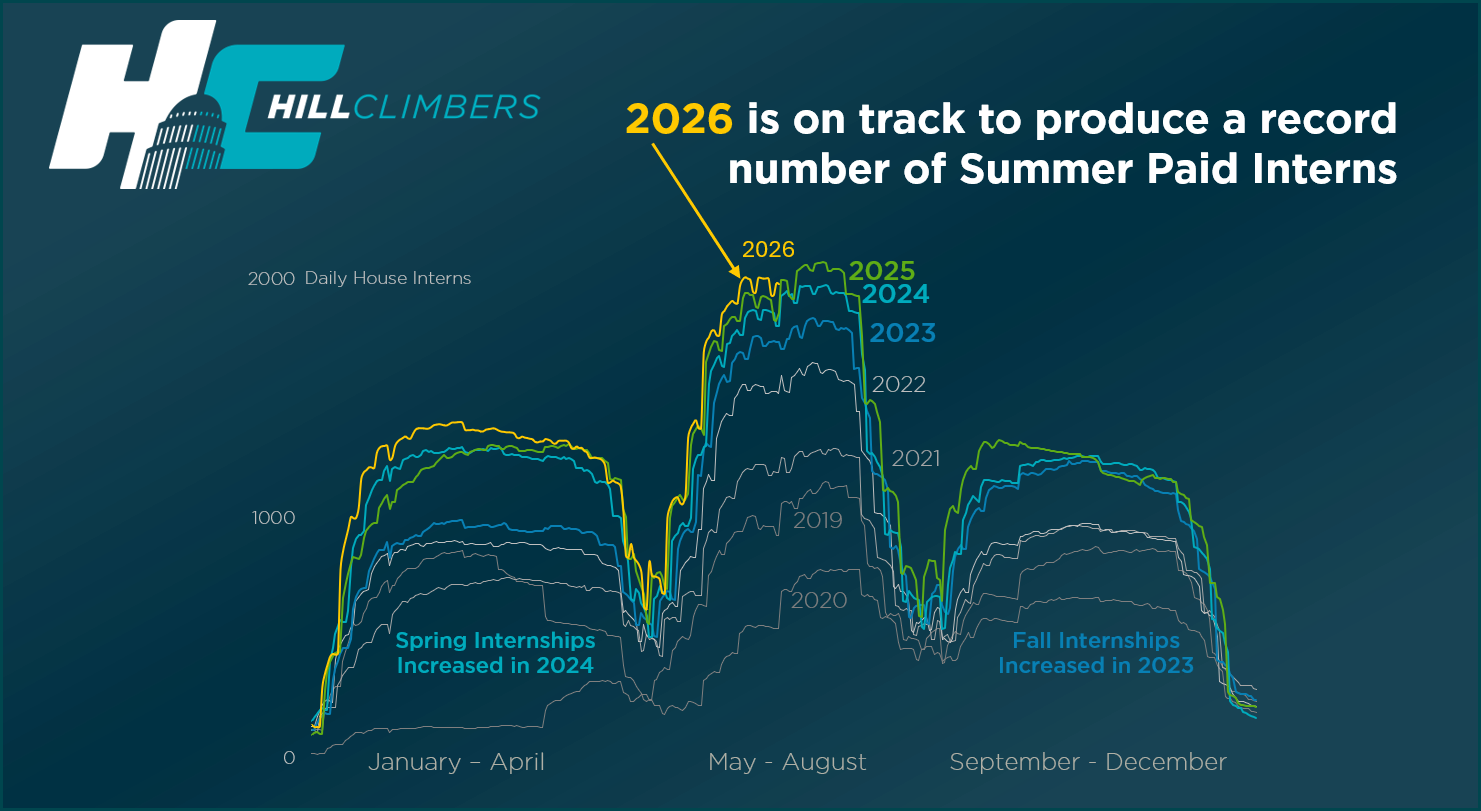
For the first time in HillClimbers' daily House staffing data, more than 2,000 paid interns were working in House offices on a single day.
It may not remain a one-year milestone for long.
New 2026 Q2 payroll data shows daily paid intern staffing already approaching 2,000 by the end of June, putting this year's summer cohort on track to challenge or surpass the record set in 2025.
There is an important caveat.
Q2 ends June 30.
The 2026 data does not yet include July or August, so HillClimbers cannot say that 2026 has already produced a record summer. That answer will come with the Q3 data.
But the starting position is striking.
The House did not cross 2,000 paid interns on a single day until 2025. One year later, it is already approaching that level before June is over.
And the summer peak is only part of what has changed.
2026 Is on Track to Produce a Record Number of Summer Paid Interns
The New Data Extends What We Already Saw This Spring
The Q2 numbers build directly on a shift HillClimbers identified earlier this year.
In June, Spring Interns Are No Longer the Warm-Up Act found that spring 2026 had already produced the largest spring intern cohort in HillClimbers' daily House data.
That mattered because summer has traditionally dominated the congressional internship calendar.
The familiar pattern was a large summer surge surrounded by much smaller spring and fall cohorts.
That pattern is becoming less pronounced.
The 2026 spring line rose above every prior spring in the dataset. Now the summer line is entering the traditional peak season near the record territory established in 2025.
The internship system is therefore changing in two ways at once.
Summer is getting larger.
The rest of the year is getting larger too.
That extends HillClimbers' earlier finding that congressional intern staffing no longer ends after summer. Beginning around 2023, fall staffing moved noticeably higher. Spring followed, particularly beginning in 2024.
The congressional internship system is not simply producing bigger summer classes. It is carrying more interns across more of the year.
That is a more significant workforce change than a single record peak.
A Peak of 2,000 Is Different From an Average of 2,000
The 2,000 threshold also needs to be understood correctly.
It does not mean the House averaged 2,000 paid interns throughout 2025.
Intern staffing moves significantly over the course of the year as cohorts arrive and depart.
HillClimbers previously found that the House averaged 1,215 paid interns per day in 2025, up from 1,036 in 2023, a 17% increase. Paid Congressional Intern Staffing Is Rising While Average Stipends Are Falling
The new milestone measures something different.
At the height of the 2025 summer cycle, the daily count crossed 2,000 for the first time.
That makes the 2026 trajectory particularly useful.
The first-half data lets us see where this year's cohort stands before the full summer peak arrives.
By June 30, it was already close.
Interns Are Becoming Part of House Workforce Infrastructure
The growth of paid internships is not automatically a problem.
Congressional internships can provide valuable professional experience, introduce students and early-career workers to public service, and give offices additional capacity.
Paid internships also represent an important improvement over an earlier model in which access to congressional experience often depended on whether someone could afford to work without compensation.
But scale changes the workforce significance of the program.
HillClimbers' special report, When Interns Become Infrastructure, found that interns had grown into one of the largest workforce groups inside House offices. The report also documented the simultaneous decline of several traditional permanent entry-level roles.
A summer internship program is one thing.
A workforce that brings in large intern cohorts during spring, summer and fall is something else.
Interns increasingly appear to provide a recurring layer of operational capacity.
They may assist with constituent correspondence, legislative research, hearing preparation, communications, front-office coverage, scheduling, administrative tasks and district operations.
That work is real.
So is the capacity it provides.
But interns remain temporary employees.
They rotate out.
They must be recruited, onboarded, trained and supervised.
That makes intern capacity different from permanent staff capacity.
The Permanent Workforce Makes the Intern Trend More Important
The timing of this growth is particularly notable because the permanent House workforce is moving in the opposite direction.
HillClimbers' previous Q2 Insight found that House Member offices averaged 6,827 non-intern staff per day during the first half of 2026, compared with 7,847 in 2010.
That is 1,020 fewer permanent staff per day, a 13% decline. The House Is Running With 1,020 Fewer Staff Than It Did in 2010
That article deliberately excluded paid interns.
This article helps explain why that distinction matters.
The permanent workforce and the intern workforce are telling different stories.
Permanent Member-office staffing remains substantially below its 2010 level.
Paid intern staffing is reaching new highs.
That does not prove a one-for-one substitution.
Congress did not simply eliminate 1,020 permanent positions and replace them with interns. Staffing decisions occur office by office, roles change, budgets change, Members change and the paid internship program has its own funding structure.
But the institutional pattern is difficult to ignore.
House offices are operating with fewer permanent staff while supporting a much larger temporary workforce than they did historically.
More interns can add capacity. They do not create the same kind of capacity as permanent staff.
That distinction should remain central to how congressional staffing is measured.
More Interns Do Not Eliminate the Need for Entry-Level Staff
The workforce-pipeline question may be even more important than the raw headcount.
HillClimbers has previously shown that traditional permanent entry-level congressional staffing has declined while internship staffing expanded.
Historically, jobs such as Staff Assistant and Legislative Correspondent formed important first steps in congressional careers.
Those positions did more than complete entry-level work.
They also created a pipeline.
Staff learned office systems, built relationships, accumulated institutional knowledge and moved into more senior legislative, communications, district and management positions.
Internships can help begin that process.
But they cannot complete it unless permanent jobs exist on the other side.
That creates an important tension.
Congress may be creating more opportunities for people to experience Capitol Hill while simultaneously maintaining fewer of the permanent entry-level positions that historically turned those experiences into careers.
HillClimbers has explored the longer-term implications in Congress May Be Trading Institutional Memory for Workforce Flexibility.
A healthy workforce probably needs both.
Accessible paid internships.
And enough permanent positions to turn promising interns and junior employees into experienced congressional staff.
Budget Pressure Is Part of the Backdrop
The intern surge is also occurring during a period of renewed pressure on Member-office resources.
HillClimbers found earlier this year that flat budgets did not produce flat staffing levels. Permanent staffing declined during the opening months of 2026 even though congressional workloads did not disappear.
The spending data showed the squeeze from another direction.
House Offices Are Running Out of Things to Cut found that average Q1 Member-office spending fell 11.5% from 2025 to 2026, including declines in both personnel and non-personnel spending.
Interns should not simply be treated as evidence of budget distress. Paid internships have independent value, and Congress specifically funded them to expand access.
But when offices face constrained permanent staffing alongside growing workloads, flexible temporary staffing may become more operationally valuable.
The data cannot tell us the motivation of every individual office.
It can show us the workforce structure those decisions are producing.
For Applicants, Summer Is Still the Biggest Window, But It Is No Longer the Only One
For students and early-career professionals, the trend has a practical implication.
Summer still matters.
It remains the largest congressional internship season and produces the highest daily staffing levels.
But an applicant who thinks only about summer is increasingly missing part of the market.
Spring 2026 has already set a record.
Fall staffing has expanded.
HillClimbers' guide to when to apply for congressional internships explains why students may need to begin planning a full semester earlier than they expect.
As internships become more continuous, they may also become more important as talent pipelines.
An intern who performs well has already learned an office's systems, culture and expectations. In a congressional hiring environment where openings can emerge quickly, that familiarity can matter.
Applicants looking beyond the internship itself can track permanent House, Senate and Hill-adjacent opportunities through the HillClimbers congressional jobs board.
Q3 Will Tell Us Whether 2026 Actually Breaks the Record
At the Q2 checkpoint, the finding is clear but incomplete.
2025 established the benchmark.
It was the first year in HillClimbers' daily House data with more than 2,000 paid interns working on a single day.
2026 is already approaching that threshold.
Now we wait for the heart of summer.
The Q3 data will add July and August and answer several questions:
- Does 2026 exceed the 2025 daily peak?
- How far above 2,000 does the intern workforce climb, if it crosses the threshold?
- How long does the summer peak last?
- How sharply does staffing fall after summer?
- Does fall 2026 continue the higher post-2023 pattern?
That last question may ultimately matter as much as the record itself.
Crossing 2,000 is a useful milestone because it shows the scale of the summer workforce.
But if spring, summer and fall all keep moving higher, the larger conclusion becomes harder to miss.
Paid interns are no longer a small workforce category sitting at the edge of congressional staffing.
They are becoming part of how House offices assemble capacity throughout the year.
The summer record is one way to see that transformation.
It is not the whole story.
FAQ
Is 2026 on track for a record number of House summer interns?
Yes. Paid House intern staffing was already approaching 2,000 people per day by the end of June 2026, putting the year on track to challenge or surpass the summer record once July and August are included. Because Q2 ends June 30, a new record cannot yet be confirmed.
When did House intern staffing first exceed 2,000 people?
Summer 2025 was the first time in HillClimbers' daily House staffing data that the number of paid interns working on a single day exceeded 2,000.
Does the 2026 Q2 data include the entire summer internship season?
No. Q2 ends June 30. July and August will be included in the Q3 data, so the current result is an early summer checkpoint rather than a final 2026 summer peak.
How many paid House interns were there in 2025?
House offices averaged 1,215 paid interns per day across 2025. The daily count varied substantially by season and exceeded 2,000 during the summer peak for the first time. HillClimbers previously found that average daily paid intern staffing increased 17% from 2023 to 2025.
Did 2026 also set a spring internship record?
Yes. Spring 2026 produced the largest spring intern cohort in HillClimbers' daily House staffing data. That finding was published in Spring Interns Are No Longer the Warm-Up Act.
Are congressional internships becoming year-round?
Increasingly, yes. Summer remains the largest season, but HillClimbers' daily staffing data shows higher spring and fall internship levels than in earlier years. The pattern suggests internships are becoming a more continuous component of House office staffing.
Are interns replacing permanent House staff?
The data does not prove direct replacement. Paid intern staffing has expanded while several permanent entry-level roles and overall non-intern staffing have declined, but that does not establish that offices eliminated specific permanent jobs in order to hire interns. The trends do show that temporary staffing now occupies a larger place in House workforce capacity.
How much has permanent House staffing declined?
At the 2026 Q2 checkpoint, House Member offices averaged 6,827 non-intern staff per day, compared with 7,847 in the comparable 2010 period. That is a decline of 1,020 staff, or 13%.
Why does growing intern staffing matter for congressional capacity?
Interns provide real operational support, but they are temporary. Larger recurring cohorts can expand office capacity while also creating recurring recruitment, training, supervision and knowledge-transfer needs. Permanent staff remain important for institutional knowledge, continuity and long-term career development.
Does HillClimbers count every intern working on Capitol Hill?
No. The analysis reflects paid interns captured in House payroll records. It does not include every volunteer intern, fellow or externally funded placement, so the broader temporary workforce may be larger.
Suggested Reading
- Spring Interns Are No Longer the Warm-Up Act
- When Interns Become Infrastructure
- Congressional Intern Staffing No Longer Ends After Summer
- Paid Congressional Intern Staffing Is Rising While Average Stipends Are Falling
- House Offices Now Employ Roughly One Intern for Every Five Staffers
- How Congress Quietly Replaced Part of Its Entry-Level Workforce
- The House Is Running With 1,020 Fewer Staff Than It Did in 2010
Explore Related HillClimbers Tools
- Explore congressional staffing data
- Learn how congressional staffing works
- Explore Member office roles
- Explore All House Staff excluding interns
- Search current congressional jobs