
Communications Is Growing While Other Permanent Pipelines Are Shrinking
Communications has become one of the clearest growth stories inside the modern House Member office.
HillClimbers' earlier analysis, House Communications Staff Salaries Sit Above Their Peers as the Team Keeps Growing, found that average daily communications staffing increased from about 474 in 2016 to 688 in 2025, growth of roughly 45%. Among the major permanent non-leadership functions, communications showed the clearest long-term staffing growth. HillClimbers
That expansion is particularly notable because it happened while many of Congress's traditional permanent entry-level positions were moving in the opposite direction.
HillClimbers found in How Congress Quietly Replaced Part of Its Entry-Level Workforce that traditional Staff Assistant, Legislative Correspondent, and Legislative Aide staffing contracted substantially from 2016 to 2025. Communications staffing was one of the exceptions, increasing while those traditional pathways shrank. HillClimbers
Congress is clearly investing more staff capacity in communications.
But the Q2 salary data reveals an important divide inside the team.
The full communications function averages $82,495.
Below the functional-leader level, the average is only:
$66,772.
The House communications team keeps growing. The staff below its functional leaders average $66,772.
That is the central finding of this update.
The Communications Team Average Hides a Much Lower Non-Leader Salary
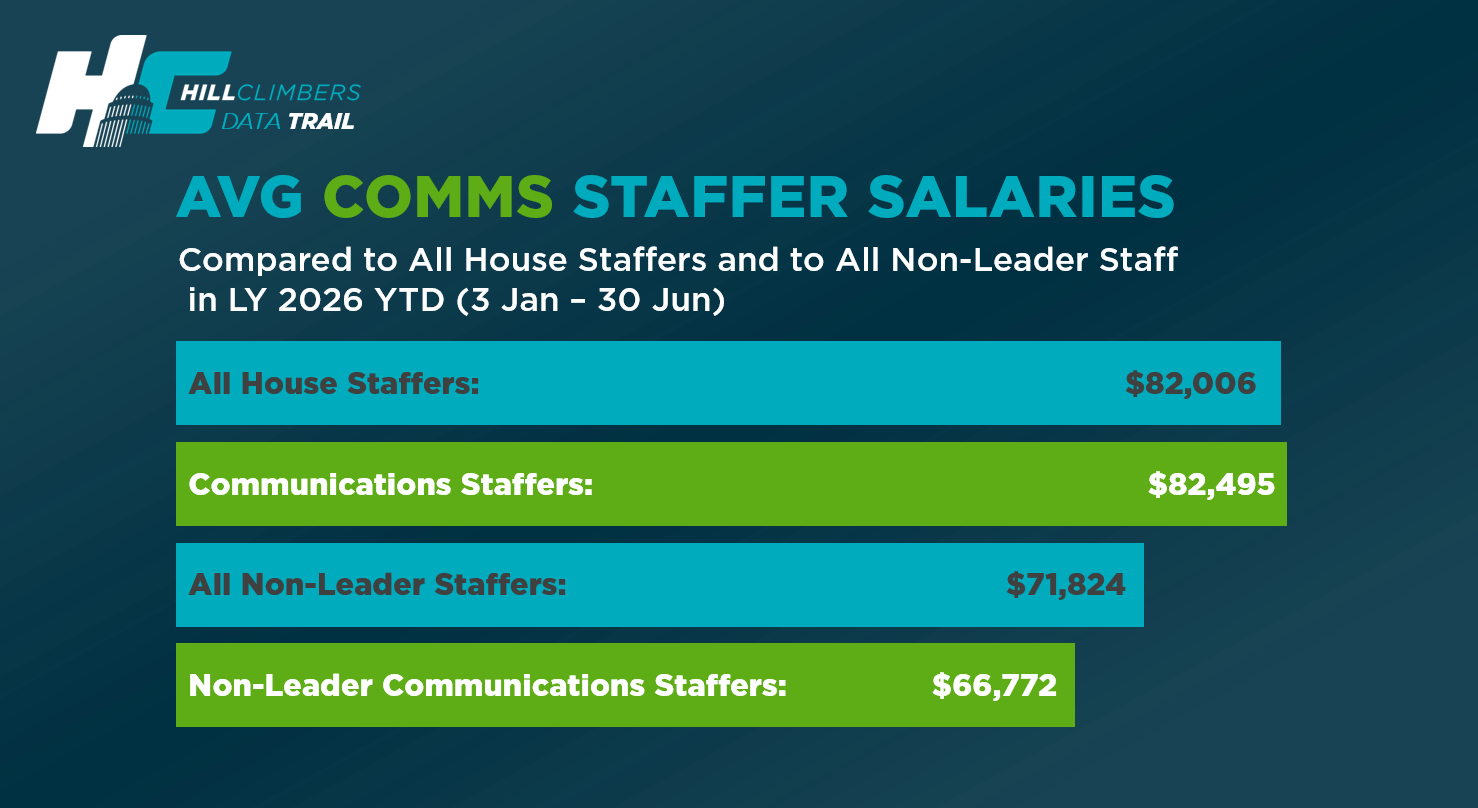
At first glance, communications pay looks almost perfectly average.
All House Staff excluding interns averaged $82,006.
Communications averaged $82,495.
Difference: just $489, or 0.6%.
But that broad number combines very different levels of the communications career ladder.
Once the functional leaders are removed, communications pay falls $15,723 below the full-team average.
It also falls $5,052, or 7.0%, below the $71,824 average for all non-leader House staff.
The House Has Built a Substantial Communications Operation
HillClimbers' Member Office Roles framework divides the communications team into three core role groups.
The Press Secretary/Communications Director is the functional leader, serving as the Member's primary spokesperson and overseeing media relations and communications strategy. HillClimbers
The Deputy Press Secretary/Digital Director includes deputy communications directors, digital directors, deputy press secretaries, digital media directors, communications managers, and related mid-level roles. HillClimbers
Communications Staff include Press Assistants, Communications Assistants, Digital Assistants, Digital Managers, speechwriters, and other employees supporting the office's public and media-facing work. HillClimbers
During the first half of 2026, the House averaged:
458 Press Secretary/Communications Director role positions per day
74 Deputy Press Secretary/Digital Director role positions per day
223 Communications Staff role positions per day
Across the six-month period, 581 people held a Press Secretary/Communications Director role, 98 held a Deputy Press Secretary/Digital Director role, and 319 held a Communications Staff role.
These are role-view figures.
They should not simply be added together and described as unique communications employees.
Someone whose title is "Deputy Chief of Staff and Communications Director," for example, legitimately appears in both role categories when the question is what work people perform.
When HillClimbers asks how many people are actually working in a Member office, however, that employee counts once. That is the person-level methodology introduced in the 2026 Q2 House staffing analysis. HillClimbers
That distinction matters especially in communications, where multiple-role work is common.
The Full-Team Average Is Being Pulled Up by the Top
The communications workforce has an unusual shape.
There are more Press Secretary/Communications Director role positions on an average day than there are general Communications Staff positions.
Those directors sit at the functional-leader level.
That helps explain why the full communications average can reach $82,495 even though the staff below that level average only $66,772.
The full-team average is not wrong.
It simply answers a different question.
It tells us what the entire communications function looks like when senior functional leadership is included.
For understanding compensation below the top, it can be misleading on its own.
Communications Looks Like a Higher-Paid Function When Leaders Are Included
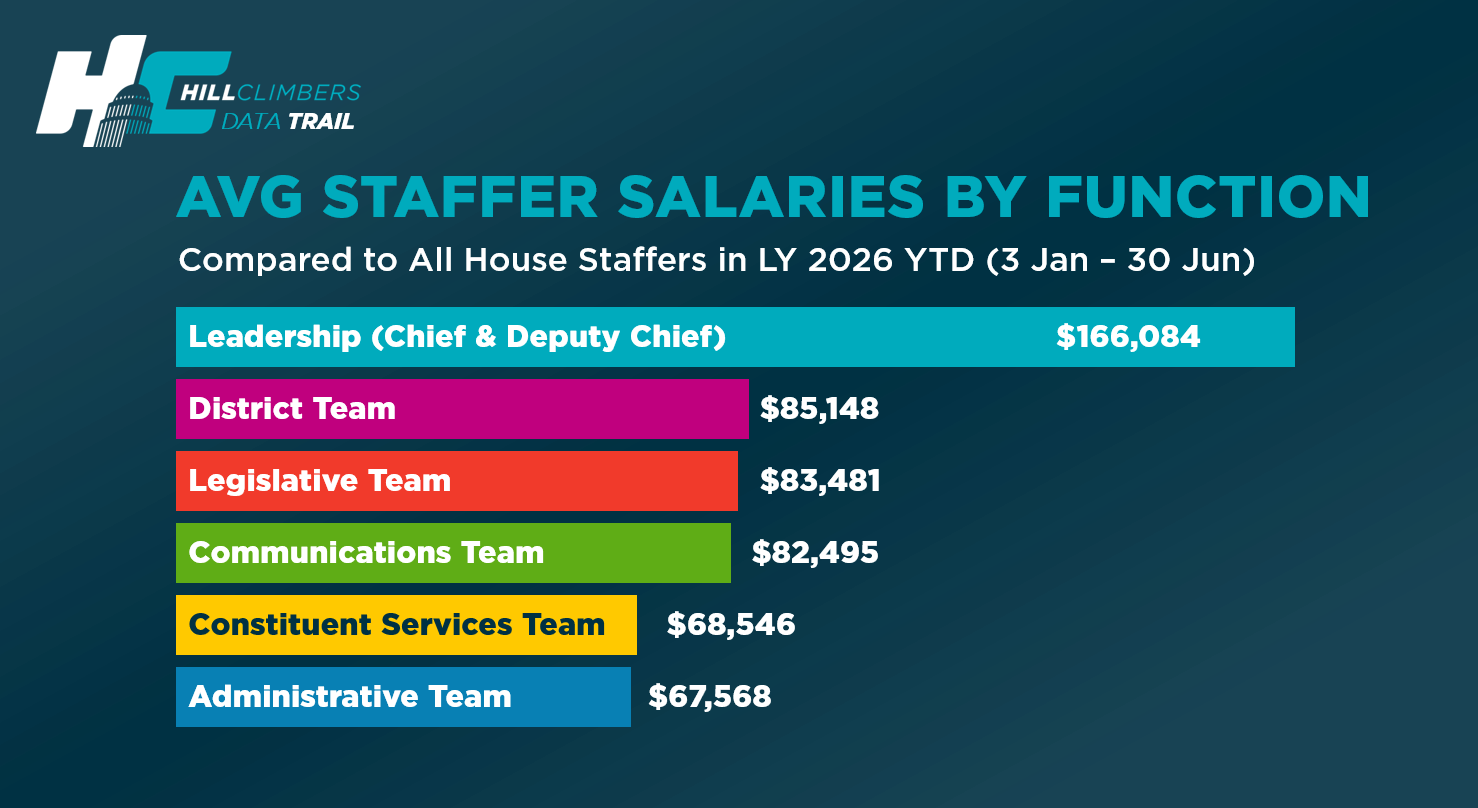
With functional leaders included, communications looks like one of the House's higher-paid teams.
The five-function comparison is:
- District: $85,148
- Legislative: $83,481
- Communications: $82,495
- Constituent Services: $68,546
- Administrative: $67,568
Communications sits just $986 below legislative staff.
It is nearly $14,000 above constituent services.
But remove the functional leaders and the structure compresses dramatically.
Below the Director Level, Communications Pay Falls to $66,772
For the updated Q2 salary series, HillClimbers uses one common definition of non-leader staff.
The population excludes Chiefs and Deputy Chiefs, non-permanent employees, and the designated functional leader of each major office team.
For communications, that means removing the Press Secretary/Communications Director.
The common non-leader benchmark is $71,824.
Against that denominator:
- Legislative: $75,444
- District: $70,514
- Communications: $66,772
- Constituent Services: $65,198
- Administrative: $64,114
The communications team is still third.
But the size of the gaps tells a different story.
Non-leader communications staff average $8,672 less than legislative staff.
They average $3,742 less than district staff.
But they are only $1,574 above constituent services and $2,658 above administrative staff.
Below the Director Level, Communications Pay Falls to $66,772
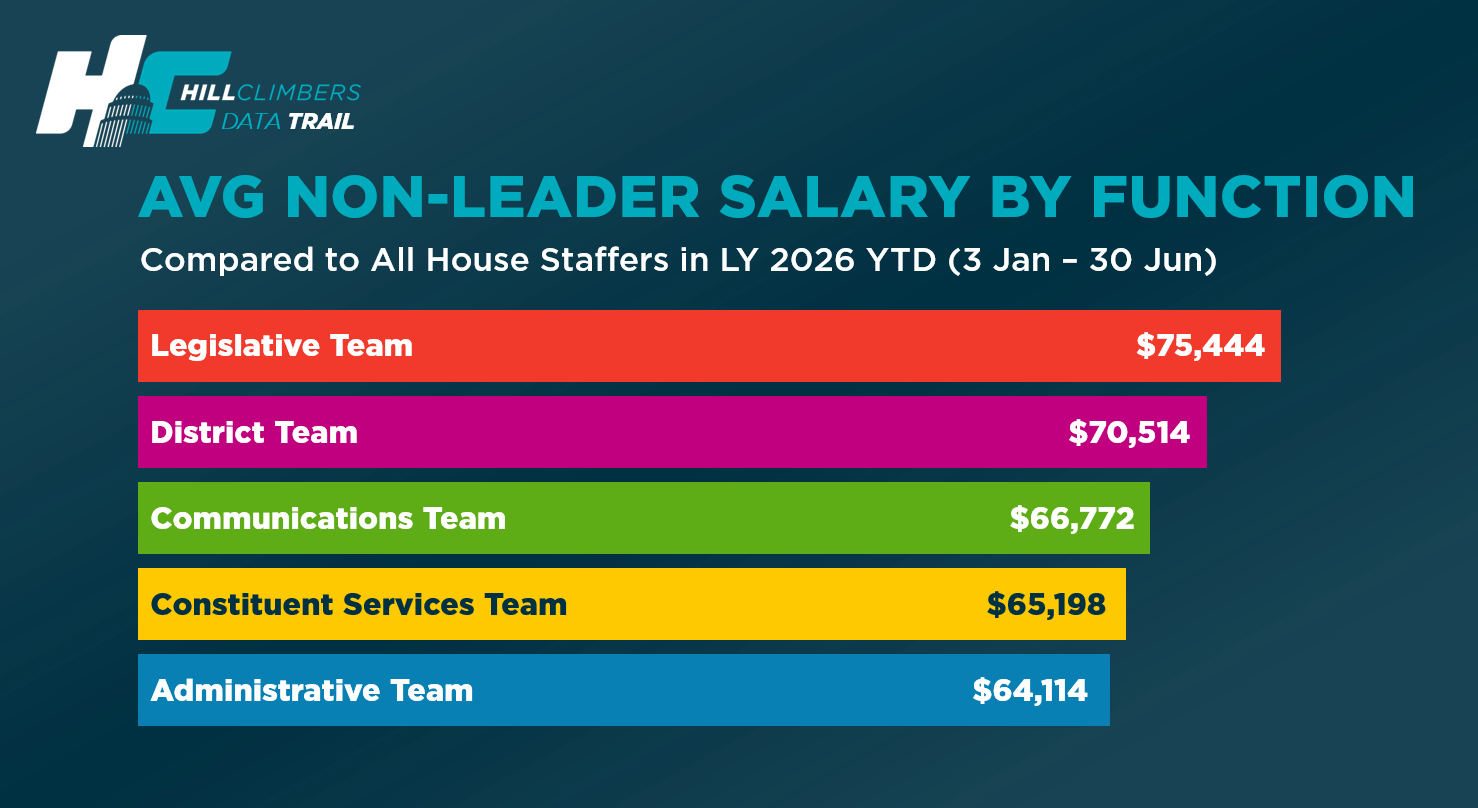
Below the Communications Director level, communications pay sits much closer to casework and administrative pay than to legislative pay.
That is a more revealing description of the compensation structure than the $82,495 full-team average alone.
Communications Is Also the Exception to the Entry-Level Contraction
The growth of communications deserves special attention because Congress has been reducing many of the positions that historically formed its permanent early-career pipeline.
HillClimbers found that combined staffing in traditional entry-level legislative roles declined by roughly 16% between 2016 and 2025. Staff Assistants and Legislative Correspondents/Aides both contracted while internship staffing expanded rapidly. HillClimbers
Communications moved differently.
The earlier HillClimbers communications analysis found a roughly 45% increase in average daily communications staffing between 2016 and 2025. HillClimbers
That means communications is not merely another House function.
It appears to be one of the places where permanent staffing capacity has actually expanded while much of the traditional junior workforce contracted.
That likely reflects a real change in what modern Member offices have to do.
Digital communications have expanded.
The speed of the news cycle has accelerated.
Members communicate directly through social platforms.
Offices produce video, graphics, newsletters, social media, websites, speeches, press releases, rapid response, local-media outreach, and national-media engagement.
HillClimbers' broader staffing research has repeatedly identified expanding communications demands as part of the workload pressure reshaping Member offices. HillClimbers
Congress has responded in part by building larger communications operations.
The more difficult question is what kind of jobs it is building underneath the director level.
Nearly One in Three Communications Staff Wears Multiple Hats
The role structure gives us part of the answer.
Among Press Secretaries and Communications Directors, 9.4% have multiple classified roles.
The most common additional role is Deputy Chief of Staff, which makes sense for a senior communications leader who may also sit within office management.
At the Communications Staff level, however, the multiple-role share jumps to:
31.7%.
Nearly one in three.
The current Communications Staff data shows Staff Assistant, Legislative Correspondent/Aide, and Field Representative among the most common additional roles. HillClimbers
That means a Communications Assistant or Press Assistant may also be helping cover front-office work.
Another may combine communications with legislative correspondence.
Another may combine press or digital work with district outreach.
By comparison, HillClimbers' More House Staff Are Wearing Multiple Hats found that 8.2% of Member office staff overall held multiple roles in 2026, the highest share in the historical office-view series. HillClimbers
At 31.7%, Communications Staff are carrying multiple roles at nearly four times the House-wide rate.
Multiple-role staffing is not automatically a sign of dysfunction.
Congressional offices are small organizations. Some overlap is rational and useful.
But when nearly a third of a junior role category is also performing another job, that tells us something about how communications growth is being structured.
Congress has added communications capacity, but nearly one in three Communications Staff is still helping cover another office function.
The Communications Career Ladder Moves Fast
Experience declines predictably as you move down the communications hierarchy.
Press Secretary/Communications Directors average 3.6 years of House experience.
Deputy Press Secretary/Digital Directors average 2.7 years.
Communications Staff average 2.0 years.
That is not surprising by itself.
Senior roles should generally contain more experienced employees.
What makes the pattern interesting is what happens when experience is viewed alongside turnover.
Role turnover is:
26.9% for Press Secretary/Communications Directors
31.7% for Deputy Press Secretary/Digital Directors
42.4% for Communications Staff
The junior communications category therefore combines the least experience, the highest multiple-role rate, and the highest role turnover.
That is a much more fluid workforce than the overall $82,495 communications average suggests.
A 42.4% Role-Turnover Rate Does Not Mean 42.4% Left Congress
The turnover measure needs an important caveat.
These are role-based turnover rates.
They measure whether someone stops holding a particular classified role.
A Communications Staff employee who is promoted to Deputy Press Secretary counts as turnover from the Communications Staff role.
A Deputy Press Secretary who becomes a Communications Director counts as turnover from the deputy role.
Someone who leaves the House entirely also counts.
But an employee who changes Member offices and remains in the same classified role does not count as role turnover.
So the 42.4% Communications Staff figure does not mean 42.4% left Capitol Hill.
Some of that turnover may represent exactly what Congress should want: promotion and career progression.
This is also why these figures should not be confused with office-view measures such as the HillClimbers Index, which assess the workforce structure and stability of a Member office rather than movement out of an occupational category.
Still, a 42.4% role-turnover rate tells us something important.
The bottom of the communications ladder turns over quickly.
Growth Does Not Automatically Mean Stability
A growing team can still be a fragile team.
In fact, rapid career movement can create its own staffing pressure.
If a Communications Staffer is promoted to Deputy Press Secretary, Congress has retained that employee.
That is good for the institution.
But the original Communications Staff position is now vacant.
Someone new has to learn the Member's voice, office priorities, district media landscape, digital systems, policy history, internal approval structure, and relationships with reporters and stakeholders.
That takes time.
The effect matters because HillClimbers has separately shown that Congress is narrowing some of the permanent entry-level pathways that historically fed more senior positions. How Congress Quietly Replaced Part of Its Entry-Level Workforce found declining Staff Assistant and Legislative Correspondent/Aide staffing as internships expanded. HillClimbers
And Congress May Be Trading Institutional Memory for Workforce Flexibility explains why that pipeline matters. Congress historically developed experienced Chiefs of Staff, Legislative Directors, Communications Directors, and other senior employees by moving permanent junior staff through progressively more responsible roles. HillClimbers
Communications appears to be one of the few areas where that permanent ladder is still expanding.
That makes the condition of its lower rungs especially important.
Communications Experience Is Institutional Knowledge Too
Communications work is fast-moving.
That does not make experience disposable.
An experienced communications employee learns how a Member speaks.
They know what the Member has said before.
They understand the district's media markets.
They know which reporters cover which issues.
They understand which subjects require rapid response and which require restraint.
They know the office's approval process.
They learn how policy, politics, constituent concerns, and public messaging intersect.
That knowledge accumulates.
When staff move up internally, much of it remains inside Congress.
When they leave entirely, some of it leaves with them.
This is why HillClimbers' broader institutional-memory research matters to the communications story. Congress historically built expertise through permanent workforce development, and shrinking or unstable pipelines can make that accumulated knowledge harder to preserve. HillClimbers
The communications function may be growing.
Its long-term capacity still depends on whether Congress can turn that growth into experienced, stable professionals.
Pay Is Only One Part of Turnover, but It Still Matters
HillClimbers has found that lower-paying congressional offices experience higher staff turnover.
Offices averaging below $69,000 in staff pay experienced turnover reaching 29.3%, while turnover became lower and more stable once office-wide average compensation moved above roughly $70,000. HillClimbers
That is an office-level finding.
The communications figures here are role-level measures.
The two should not be collapsed into a claim that a $66,772 communications average causes 42.4% role turnover.
The data does not establish that.
Role movement can reflect promotion, career changes, departures from Congress, and other factors.
But compensation remains part of the workforce environment.
A growing communications team still has to recruit people.
It has to develop them.
It has to give them a reason to remain long enough to become experienced.
And below the functional-leader level, it is trying to do that with an average salary of $66,772.
Flat Budgets Put the Growing Team Under Pressure
Communications growth is also running into the same financial constraint affecting the rest of the House workforce.
Member offices operate within the Member Representational Allowance, which has to fund salaries along with district operations, travel, technology, communications, rent, and other office expenses.
HillClimbers has shown that House staffing expanded when Congress increased office resources and began weakening again as budgets flattened. HillClimbers
That pressure is now visible in the broader workforce.
The 2026 Q2 staffing analysis found Member offices averaging 6,827 non-intern staff per day, 13% below the comparable 2010 level. HillClimbers
HillClimbers has also found that flat budgets in a rising-cost environment can mean slower hiring, smaller raises, delayed promotions, longer vacancies, and increased reliance on junior staff. HillClimbers
For communications, those pressures create a difficult equation.
The function has grown because offices increasingly need communications capacity.
But its lower levels are relatively low paid, frequently multi-role, and highly fluid.
A flat nominal budget means less real purchasing power to sustain that growth.
Why the Numbers Changed From the Earlier Communications Article
This article updates HillClimbers' earlier House communications salary analysis.
That analysis reported a $84,601 communications team average using LY 2025 YTD data. HillClimbers
The new Q2 2026 full-team average is $82,495.
Those figures should not be interpreted as a simple $2,106 year-over-year salary decline.
HillClimbers changed the underlying methodology.
The revised House-wide calculations use a person-level approach for aggregate measures. Someone with multiple roles counts once when measuring the size of the workforce, while continuing to appear in each role they actually perform when HillClimbers analyzes individual roles. HillClimbers
The non-leader comparison has also been standardized across the new five-part salary series.
The updated methodology:
- classifies Chiefs and Deputy Chiefs as leadership
- removes each team's functional leader
- excludes interns, temporary staff, and part-time employees
- keeps the highlighted function inside the common All Non-Leader Staff benchmark
That creates one consistent $71,824 comparison point across legislative, constituent services, communications, district, and administrative staff.
The new Q2 figures are therefore the better benchmark going forward.
The Growth Story Makes the $66,772 More Important
The most interesting thing about communications is not that its full-team salary average is almost identical to the House average.
It is that Congress has been building this function.
Communications staffing grew roughly 45% between 2016 and 2025 even as several traditional permanent entry-level roles contracted. HillClimbers
That tells us Member offices have increasingly prioritized communications capacity.
But below the functional-leader level:
Average pay is $66,772.
Communications Staff average 2.0 years of House experience.
31.7% carry multiple roles.
Role turnover reaches 42.4%.
Those numbers suggest that Congress is building a larger communications workforce partly through a relatively junior, highly mobile, frequently multi-role layer beneath its Communications Directors.
That is not necessarily an unsustainable model.
But it is a model worth watching.
Congress has made communications a larger part of the Member office. The next question is whether it is investing enough in the people filling that growth.
Congressional capacity is staff capacity.
And in the modern House, communications capacity has clearly become a larger part of what that means.
This Is the Third Update in the Five-Part Q2 Salary Series
This communications analysis follows HillClimbers' updated legislative staff salary analysis and constituent services salary analysis. The legislative update found a $75,444 non-leader average, while the constituent services update found a $65,198 average and highlighted how experience and multiple-role staffing change the meaning of team-level compensation. HillClimbers
The remaining updates will examine district and administrative staff before HillClimbers brings all five functions together into a broader report on compensation, experience, turnover, role structure, and workforce capacity across the modern House Member office.
FAQ
How much do House communications staff make in 2026?
The full House communications function averaged $82,495 through June 30, 2026. Communications employees below the Press Secretary/Communications Director level averaged $66,772.
Why is the full communications salary so much higher than the non-leader average?
The $82,495 team average includes Press Secretaries and Communications Directors, who lead the communications function. Removing those functional leaders lowers the average to $66,772.
Is the House communications workforce growing?
Yes. HillClimbers previously found that average daily communications staffing increased from about 474 in 2016 to 688 in 2025, growth of approximately 45%. Communications showed the clearest long-term growth among the major permanent non-leadership functions. HillClimbers
Is communications growing at the entry level too?
Communications has been an exception to the broader decline in permanent entry-level staffing. HillClimbers found communications staffing increasing while traditional Staff Assistant, Legislative Correspondent, and Legislative Aide roles contracted. HillClimbers
How many Press Secretary/Communications Director roles are there?
The House averaged 458 Press Secretary/Communications Director role positions per day during the first half of 2026. Across the period, 581 people held that role.
How many Deputy Press Secretary/Digital Director roles are there?
The House averaged 74 Deputy Press Secretary/Digital Director role positions per day, with 98 people holding the role during the first half.
How many Communications Staff roles are there?
The House averaged 223 Communications Staff role positions per day. Across the period, 319 people held the role.
How experienced are House communications staff?
Press Secretary/Communications Directors averaged 3.6 years of House experience, Deputy Press Secretary/Digital Directors averaged 2.7 years, and Communications Staff averaged 2.0 years.
How many Communications Staff carry multiple roles?
31.7% of Communications Staff carry multiple classified roles. Common additional roles include Staff Assistant, Legislative Correspondent/Aide, and Field Representative.
What is the turnover rate for House communications roles?
Role turnover was 26.9% for Press Secretary/Communications Directors, 31.7% for Deputy Press Secretary/Digital Directors, and 42.4% for Communications Staff.
Does 42.4% role turnover mean 42.4% of Communications Staff left the House?
No. Role turnover includes people who stop holding the role because they are promoted or move into a different classified role, as well as people who leave the House entirely. Someone who changes offices but remains in the same role does not count as role turnover.
How does communications pay compare with other non-leader teams?
Non-leader communications staff averaged $66,772. That was below legislative staff at $75,444 and district staff at $70,514, but above constituent services at $65,198 and administrative staff at $64,114.
Where can I find current congressional communications jobs?
Current openings are available on the HillClimbers Congressional Jobs Board. Readers can also explore the Press Secretary/Communications Director, Deputy Press Secretary/Digital Director, and Communications Staff pages.
Suggested Reading
- House Communications Staff Salaries Sit Above Their Peers as the Team Keeps Growing
- How Congress Quietly Replaced Part of Its Entry-Level Workforce
- Congress May Be Trading Institutional Memory for Workforce Flexibility
- More House Staff Are Wearing Multiple Hats
- The Staff Helping Shape the Nation's Laws Average $75,444
- The House Staff that Constituents Rely On Average $65,198
- Congressional Staffing Levels Rise Or Fall Based On How Much Congress Invests In Itself
- Low-Paying Congressional Offices Experience the Highest Staff Turnover
Explore Related HillClimbers Tools
- Press Secretary/Communications Director
- Deputy Press Secretary/Digital Director
- Communications Staff
- Explore Member Office Roles
- Explore All House Staff Excluding Interns
- Explore Congressional Staffing Data
- Learn How Congressional Staffing Works
- Explore the Congressional Dataset
- Explore the HillClimbers Index
- View Current Congressional Jobs