
The People Constituents Call When Government Is Not Working
For many Americans, a congressional office becomes most important when something has gone wrong.
A Social Security payment does not arrive.
A veterans claim stalls.
A passport is delayed.
An immigration case stops moving.
An IRS problem cannot be resolved.
A federal agency will not provide an answer.
That is where the constituent services team comes in.
A Constituent Services Representative/Caseworker helps constituents navigate problems involving federal agencies. A Manager of Constituent Services/Casework helps oversee that work and keep the office's casework operation moving.
These are among the most directly public-facing employees in Congress.
And among House constituent services staff below the functional-leader level, their average salary through June 30, 2026 was:
$65,198.
The House staff constituents turn to when the federal government is not working average $65,198.
That number matters on its own.
It matters even more when we look at who is doing the work.
This Is Not an Entry-Level Workforce
The average House CSR/Caseworker has 4.4 years of House or Member-office experience.
That should change how the $65,198 salary benchmark is understood.
This is not primarily a workforce of new congressional employees still learning how an office works.
On average, CSR/Caseworkers have already spent nearly four and a half years building congressional experience.
During that time, they learn office systems, federal-agency processes, privacy requirements, documentation rules, escalation paths, and the practical realities of helping people navigate federal bureaucracy.
A new employee can learn those things.
An experienced employee already knows them.
That difference is part of the value an office loses when an experienced caseworker leaves.
The average House CSR/Caseworker has 4.4 years of congressional experience. The non-leader constituent services team averages $65,198.
The salary number is therefore not notable simply because constituent services ranks near the bottom of the House pay structure.
It is notable because Congress is paying roughly that amount across a function populated by staff who have already accumulated years of institutional experience.
The House Staff Constituents Rely On Average $65,198
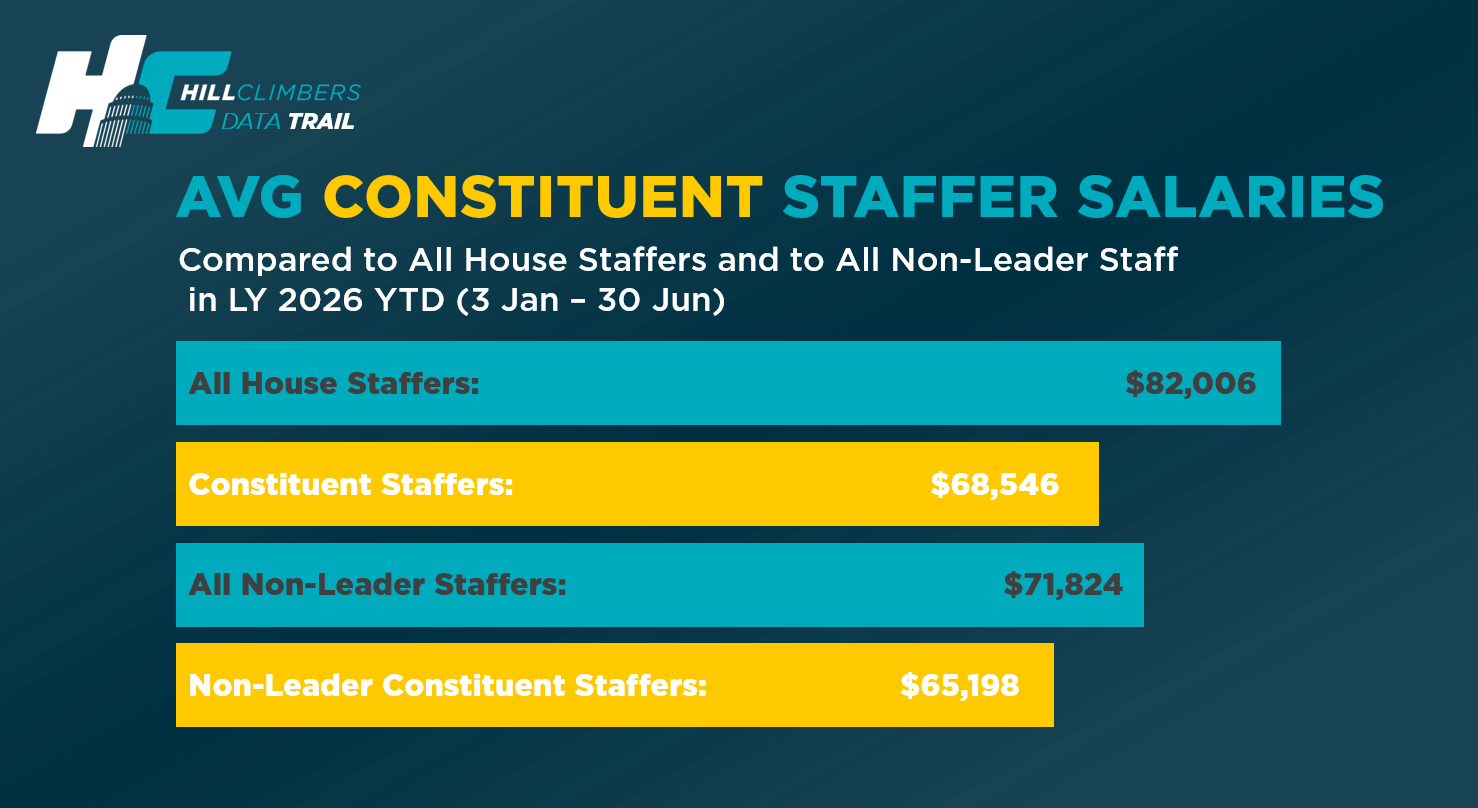
The full constituent services team averaged $68,546.
That is $13,460 below the $82,006 average for All House Staff excluding interns, a gap of 16.4%.
But the cleaner comparison comes after removing the functional leader.
Non-leader constituent services staff averaged $65,198.
All non-leader House staff averaged $71,824.
That is $6,626 less, or 9.2%.
Casework Is a Large Part of the House Workforce
The scale of the role matters too.
During the first half of 2026, the House averaged 823 Constituent Services Representatives/Caseworkers working each day.
Across the six-month period, 942 people held the CSR/Caseworker role at some point.
At the next level, the House averaged 64 Managers of Constituent Services/Casework per day, while 74 people held that role at some point during the first half.
The distinction between those numbers is important.
The daily average tells us roughly how much role capacity was present on a typical day.
The total count tells us how many different people occupied that role at some point during the period.
They should not be treated as the same measure.
They also should not simply be added together and described as unique House employees. HillClimbers' updated person-level staffing methodology distinguishes between counting people and counting the roles they perform.
That distinction is especially important in constituent services.
Because a lot of caseworkers are doing more than casework.
Nearly One in Five CSR/Caseworkers Carries Another Role
19.7% of House CSR/Caseworkers have multiple classified roles.
That is nearly one in five.
By comparison, HillClimbers' broader multiple-role staffing analysis found that 8.2% of Member office staff held multiple roles in 2026, the highest share in the historical office-view series.
The CSR/Caseworker rate is more than twice that House-wide share.
This is an important distinction because headcount alone cannot show how work is distributed.
A caseworker can still appear in the office headcount as one employee while also carrying responsibilities that belong to another function.
HillClimbers uses an office-view, person-level methodology for this reason. Each person is counted once when measuring the size of an office, while a primary role and, when the title clearly reflects it, a secondary role can show how that person's work is divided.
Multiple-role staffing is not inherently a problem.
In a small congressional office, combining responsibilities can be practical and intentional.
But when nearly one in five employees in a particular role is also carrying another role, it becomes part of the capacity story.
Nearly one in five House CSR/Caseworkers is not only doing casework. They are carrying another office role too.
That makes the $65,198 average harder to view simply as the going rate for one narrowly defined job.
A meaningful share of the workforce is being paid within that compensation structure while helping offices cover more than one function.
Constituent Services Remains Near the Bottom of the House Pay Structure
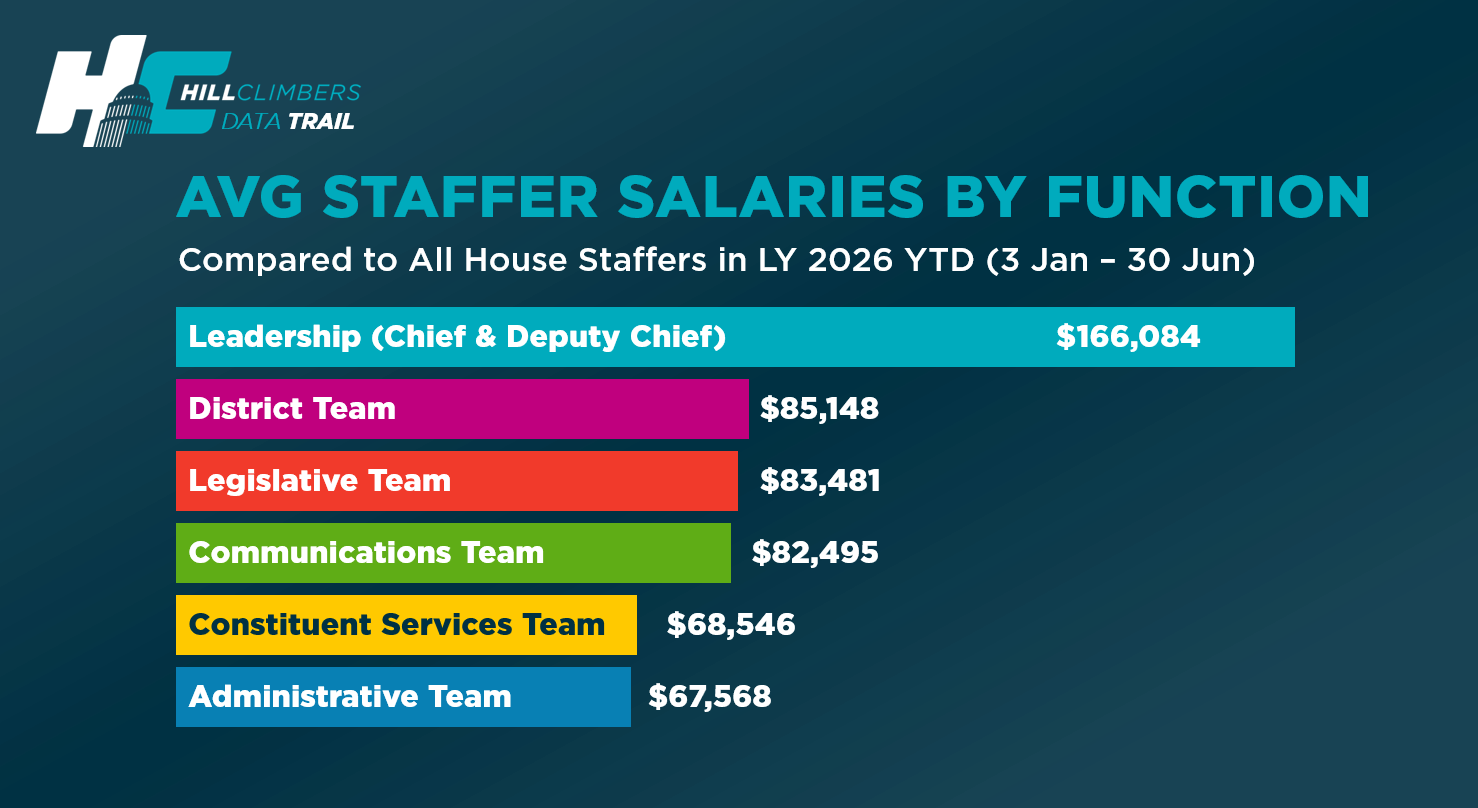
Across the five major Member office functions, average salaries through Q2 2026 were:
- District Team: $85,148
- Legislative Team: $83,481
- Communications Team: $82,495
- Constituent Services Team: $68,546
- Administrative Team: $67,568
Constituent services ranks fourth of five.
Only administrative staff average less.
The difference between those two lower-paid functions is small: $978.
The gap to the rest of the office is much larger.
Communications staff average $13,949 more than constituent services.
Legislative staff average $14,935 more.
District staff average $16,602 more.
Constituent Services Remains Near the Bottom of the House Salary Structure
The ranking is slightly different from HillClimbers' earlier constituent services salary analysis, which placed constituent services last under the previous methodology.
The methodology changed.
The broader finding did not.
Constituent services and administrative staff continue to occupy a substantially lower compensation tier than legislative, district, and communications staff.
Remove Functional Leaders and the Pattern Is Even Clearer
For this updated five-part salary series, HillClimbers uses one consistent definition of a non-leader staffer.
The population excludes Chiefs and Deputy Chiefs, non-permanent staff such as interns, part-time employees, and temporary employees, and the functional leader of each major team:
- Legislative Director
- Press Secretary/Communications Director
- District Director
- Director of Constituent Services/Casework
- Director of Operations
Everyone else in the five permanent functions remains in the benchmark.
That produces one common $71,824 All Non-Leader Staff average for every article in the series.
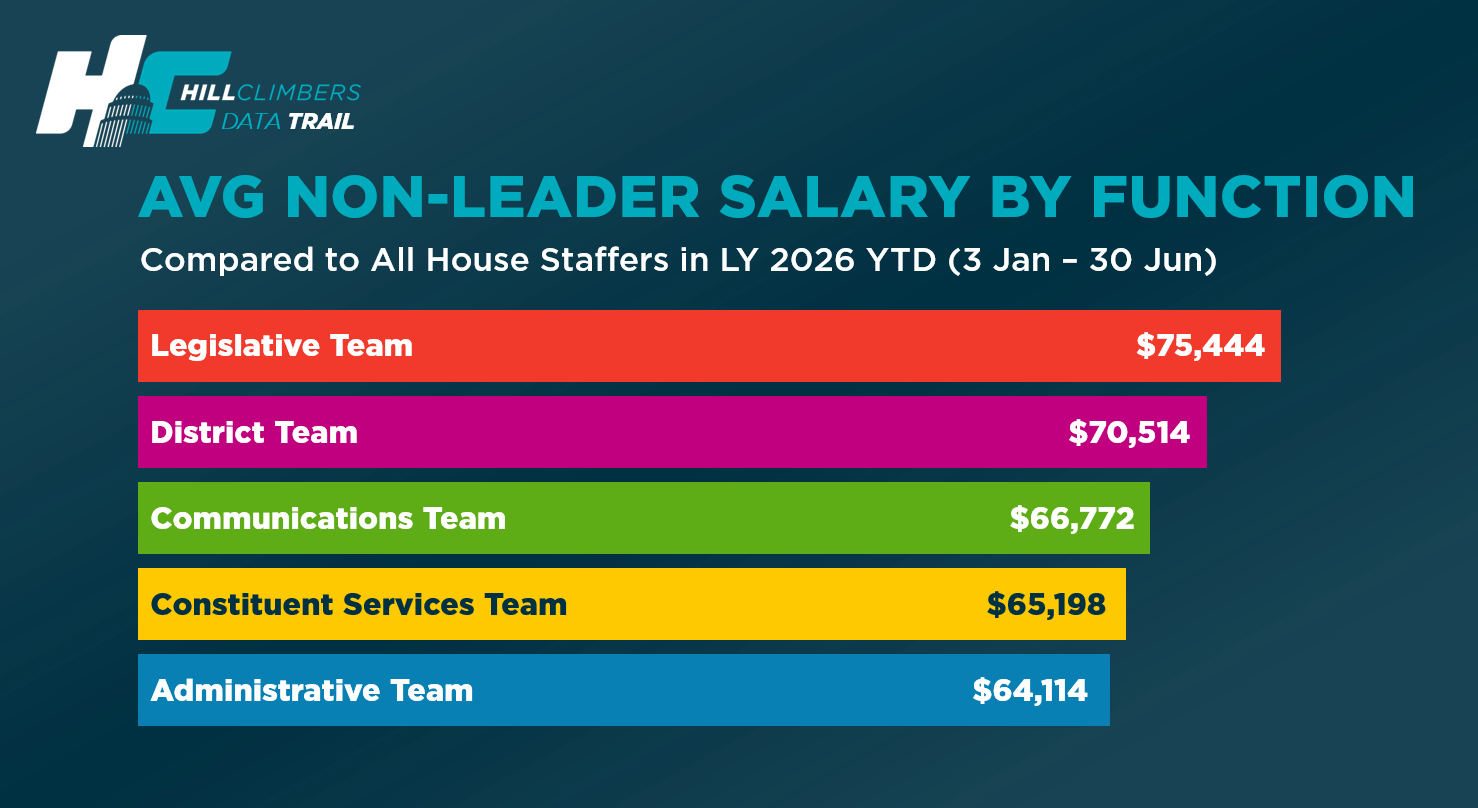
The functional comparison is:
- Legislative Team: $75,444
- District Team: $70,514
- Communications Team: $66,772
- Constituent Services Team: $65,198
- Administrative Team: $64,114
Constituent services remains second from the bottom.
It is $1,084 above administrative staff.
It is $1,574 below communications.
$5,316 below district.
And $10,246 below legislative staff.
The first article in this Q2 series, The Staff Helping Shape the Nation's Laws Average $75,444, showed the top of the non-leader functional pay structure.
Constituent services shows the other end.
Below the Functional-Leader Level, Constituent Services Averages $65,198
The point is not that every congressional function should necessarily have the same average salary.
The roles have different labor markets, career ladders, experience profiles, and responsibilities.
The more important question is whether the compensation available within each function is sufficient to recruit and retain the experience that the office needs.
For constituent services, the 4.4-year experience level makes that question harder to ignore.
Casework Depends on Knowledge That Takes Time to Build
Constituent casework can look straightforward from the outside.
A constituent has a problem.
The congressional office contacts the agency.
The agency responds.
But difficult cases are rarely that simple.
Different federal agencies have different systems, timelines, documentation requirements, privacy rules, appeals processes, and escalation procedures.
An experienced caseworker knows more than where to send an email.
They learn how an agency operates.
They learn what information is likely to be missing.
They learn when a delay is ordinary and when something has gone wrong.
They build relationships with agency contacts.
They learn how to explain complicated federal processes to constituents who may be frustrated, confused, or facing serious financial and personal consequences.
That is why the 4.4-year average experience level matters.
House offices have already invested years in developing these employees.
Losing them means replacing more than a headcount.
It can mean replacing accumulated institutional and agency knowledge.
HillClimbers has found more broadly that House staff experience has been rising while Member tenure has fallen, increasing the importance of staff to institutional continuity.
That principle applies to constituent service just as much as it applies to legislation.
Low Pay Can Become a Retention Problem
Compensation matters because workforce stability matters.
In Low-Paying Congressional Offices Experience the Highest Staff Turnover, HillClimbers found that offices averaging below $69,000 in staff pay experienced turnover reaching 29.3%. Turnover became lower and more stable once office-wide average pay moved above roughly $70,000.
That is an office-level finding, not a constituent-services-specific turnover rate.
The $65,198 constituent services average therefore should not be plugged into that analysis and treated as proof that caseworkers experience 29.3% turnover.
But the relationship still matters.
Compensation is one component of an office's ability to retain experienced employees.
And for casework, the cost of losing someone can be particularly tangible because knowledge accumulates over years.
The multiple-role rate adds another dimension.
When 19.7% of CSR/Caseworkers carry more than one role, losing one person may create more than one operational gap.
A departure can reduce casework capacity while also removing support from another office function.
That is where salary, experience, role structure, and retention begin to intersect.
Casework Capacity Is More Than a Headcount
The House averaged 823 CSR/Caseworkers per day during the first half of 2026.
That is an important measure of capacity.
It is not a complete one.
Three facts tell us more:
The average CSR/Caseworker has 4.4 years of House or Member-office experience.
19.7% hold multiple roles.
The non-leader constituent services function averages $65,198.
Those measures capture different parts of the workforce.
How many people are available?
How much experience do they have?
How concentrated or stretched is their work?
How much does Congress pay them?
Headcount alone cannot answer those questions.
A workforce can maintain the same number of employees while becoming less specialized.
It can preserve positions while losing experienced people.
It can continue providing a service because remaining employees absorb additional functions.
That is why HillClimbers' Q2 staffing analysis looks beyond a single headcount number.
Congressional capacity is not simply how many names are on the payroll.
It is what that workforce has enough time, experience, specialization, and resources to do.
Flat Budgets Leave Less Room to Fix the Pay Gap
The constituent services salary story is unfolding inside a broader office budget squeeze.
In House Offices Are Running Out of Things to Cut, HillClimbers found that average Member office spending fell 11.5% from 2025 Q1 to 2026 Q1.
Personnel spending fell 3.3%.
Non-personnel spending fell 30.3%.
Offices appear to have cut much more deeply outside payroll in an effort to preserve staffing capacity.
But personnel spending still fell.
That matters because a Member office operates with one constrained Member Representational Allowance.
The same budget has to support staff salaries, supplies, mail, rent, travel, and other office needs.
When the nominal budget stays flat while costs rise, its real purchasing power falls.
That means less room for raises.
Less room to fill vacancies.
Less room to add specialized staff.
And less room to increase compensation for an experienced caseworker who is already carrying another role.
HillClimbers has documented the broader relationship in Congressional Staffing Levels Rise Or Fall Based On How Much Congress Invests In Itself.
The House demonstrated that additional investment could rebuild staffing capacity.
Flat budgets are now squeezing that capacity again.
Why the Numbers Changed From the Earlier Article
This article updates HillClimbers' earlier analysis, House Constituent Services Staff Are the Lowest-Paid Major Team.
That analysis reported a $70,466 constituent services team average using LY 2025 YTD data.
The new Q2 full-team figure is $68,546.
Readers should not interpret that as a simple $1,920 year-over-year salary decline.
The methodology has changed.
HillClimbers' revised House-wide calculations now use a person-level approach for aggregate measures. A staffer with multiple roles counts once when measuring the number of people working in a Member office, while those roles can still be analyzed separately when studying how work is distributed.
The non-leader comparison has also been standardized.
The earlier series included Deputy Chiefs within the non-leadership comparison and removed the highlighted functional team from its peer benchmark.
The new methodology:
- classifies Chiefs and Deputy Chiefs as leadership
- removes the leader of each major function
- excludes interns, temporary staff, and part-time employees
- keeps the highlighted function inside the common All Non-Leader Staff benchmark
That gives every article in the updated five-part series the same $71,824 comparison point.
The new Q2 figures are therefore the better benchmark going forward.
The Ranking Change Is Not the Story
Under the previous methodology, constituent services ranked last.
Under the updated Q2 methodology, administrative staff average slightly less.
That change deserves to be reported accurately.
It does not deserve to dominate the article.
The difference between the two non-leader averages is only $1,084.
The more revealing facts are these:
The average CSR/Caseworker has 4.4 years of congressional experience.
Nearly one in five holds multiple roles.
The House relies on an average of 823 CSR/Caseworkers every day.
And the non-leader constituent services function averages $65,198.
This is not a low-paid entry-level workforce. It is an experienced frontline workforce Congress relies on every day.
That is the story.
Congressional Capacity Is Also Constituent Service Capacity
Public discussions about congressional capacity often focus on legislative expertise.
That matters.
But Congress is also a service institution.
Every House Member represents hundreds of thousands of people who interact with federal programs, benefits, rules, and agencies.
When those systems fail them, their Member's office may be one of the few places they can turn.
For those constituents, congressional capacity becomes very practical.
Does someone answer?
Does that person understand the problem?
Do they know the agency?
Do they know how to escalate the case?
Do they have enough time to manage it?
Will they still be there when the next problem arises?
The House's constituent services workforce helps answer those questions every day.
The Q2 data shows Congress relying on a large, experienced workforce, nearly one-fifth of whom carry multiple roles, while paying the non-leader function an average of $65,198.
Congressional capacity is staff capacity.
For constituents waiting on a veterans benefit, passport, immigration case, tax issue, Social Security payment, or another federal service, that capacity is not an abstraction.
It is whether someone in their congressional office can help.
This Is the Second Update in the Five-Part Q2 Salary Series
This article follows HillClimbers' updated legislative staff salary analysis, which found that non-leader legislative staff averaged $75,444 through Q2.
The updated series examines all five major Member office functions:
- Legislative staff
- Constituent services staff
- Communications staff
- District staff
- Administrative staff
Once all five are complete, HillClimbers will bring the findings together into a broader report examining how compensation, experience, office structure, and workforce capacity differ across the modern House Member office.
FAQ
How much do House congressional casework staff make?
The combined non-leader constituent services function averaged $65,198 through June 30, 2026. This includes CSR/Caseworkers and Manager-level constituent services staff below the Director of Constituent Services/Casework, so it should not be interpreted as the salary of one specific role.
How experienced is the average congressional caseworker?
The average House CSR/Caseworker has 4.4 years of House or Member-office experience. That means this is not primarily an entry-level workforce.
How many House CSR/Caseworkers are there?
The House averaged 823 CSR/Caseworkers per day during the first half of 2026. Across the period, 942 people held the role at some point.
How many constituent services managers are there?
The House averaged 64 Managers of Constituent Services/Casework per day during the first half of 2026. 74 people held the role at some point during the period.
How many House caseworkers hold multiple roles?
19.7% of CSR/Caseworkers hold multiple classified roles, or nearly one in five. That is more than twice the 8.2% multiple-role share across Member office staff overall.
Are constituent services staff the lowest-paid House team?
Not under the updated Q2 methodology. Non-leader administrative staff averaged $64,114 compared with $65,198 for constituent services. Constituent services therefore ranks second-lowest among the five non-leader functions.
How does constituent services pay compare with other non-leader House staff?
All non-leader House staff averaged $71,824. Constituent services averaged $65,198, which is $6,626 or 9.2% lower.
How much less do constituent services staff make than legislative staff?
Non-leader legislative staff averaged $75,444 compared with $65,198 for constituent services, a difference of $10,246, or about 13.6%.
Does the $65,198 figure mean the average CSR/Caseworker makes $65,198?
No. The $65,198 figure covers the combined non-leader constituent services function, including CSR/Caseworkers and Managers of Constituent Services/Casework. For an individual job or salary negotiation, use the relevant CSR/Caseworker or Manager of Constituent Services/Casework role-level data.
Why does caseworker experience matter?
Federal casework depends on knowledge of agency processes, documentation requirements, escalation paths, office systems, and constituent-service practices. Much of that knowledge accumulates over time, so turnover can reduce more than headcount.
Does lower pay cause caseworker turnover?
This analysis does not establish a caseworker-specific causal relationship. HillClimbers has found that lower-paying offices experience higher turnover, with turnover reaching 29.3% among offices averaging below $69,000 in staff pay. That is an office-level finding and should not be treated as a turnover rate for constituent services employees.
Where can I find current congressional caseworker jobs?
Current openings are available on the HillClimbers Congressional Jobs Board. Readers can also explore the CSR/Caseworker and Manager of Constituent Services/Casework pages.
Suggested Reading
- The Staff Helping Shape the Nation's Laws Average $75,444
- House Constituent Services Staff Are the Lowest-Paid Major Team
- More House Staff Are Wearing Multiple Hats
- Low-Paying Congressional Offices Experience the Highest Staff Turnover
- Institutional Knowledge in Congress Is Increasingly Held by Staff
- The House Staffing Rebound Is Unwinding
- The House Is Running With 1,020 Fewer Staff Than It Did in 2010
- House Offices Are Running Out of Things to Cut
Explore Related HillClimbers Tools
- Constituent Services Representative/Caseworker
- Manager of Constituent Services/Casework
- Explore Member Office Roles
- Explore All House Staff Excluding Interns
- Explore Congressional Staffing Data
- Learn How Congressional Staffing Works
- Explore the Congressional Dataset
- Explore the HillClimbers Index
- View Current Congressional Jobs