
Congressional Career Opportunities May Follow a Different Pattern Than Most Students Expect
Students pursuing careers on Capitol Hill often focus on prestige.
The assumption is straightforward: the best internships and career opportunities are probably found in the offices of powerful senior Members with established reputations, major committee influence, and large policy operations.
But congressional workforce data suggests another dynamic may matter just as much:
timing.
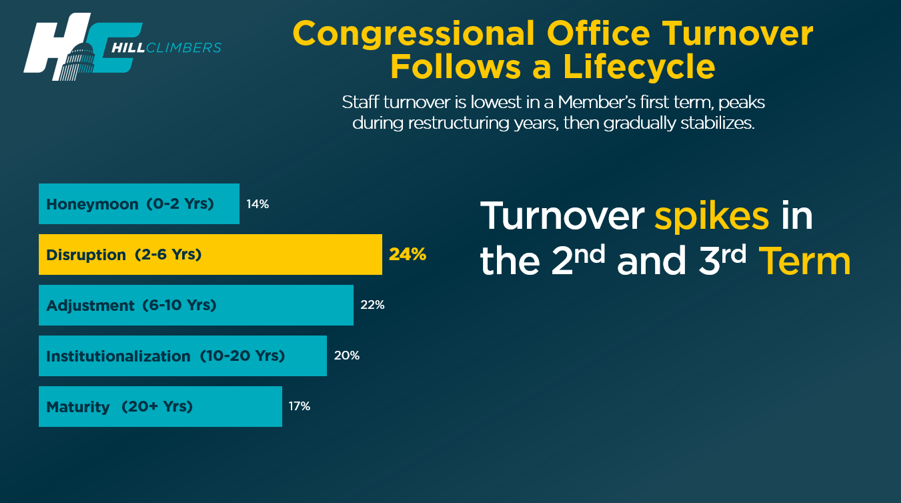
Earlier HillClimbers analysis found that congressional office turnover appears to follow a recognizable organizational lifecycle, with turnover peaking during a Member’s second and third terms.
Congressional Office Turnover Appears to Follow a Predictable Lifecycle
That staffing pattern may have important implications for interns and early-career job seekers trying to break into Congress.
Congressional hiring opportunity may follow organizational cycles as much as institutional prestige.
This matters because congressional offices are not static workplaces. They evolve as Members gain experience, teams restructure, workloads grow, and offices move from campaign-style launch teams into more formal congressional operations.
For applicants, that means the best opportunity may not always be found in the most famous office.
It may be found in an office entering the part of its lifecycle where staffing movement is most likely.
Congressional Office Turnover Peaks After the First Term
HillClimbers congressional workforce analysis found that turnover is lowest during a Member’s first term at roughly 14%.
But during years 2–6, average turnover rises sharply to approximately 24%, the highest point observed across the congressional office lifecycle.
Congressional Office Turnover Peaks During the Second and Third Terms
Why might that happen?
Freshman offices often launch with campaign-era cohesion. Early teams may be united by shared political identity, startup-style energy, and strong mission alignment.
But congressional offices evolve quickly.
As offices mature:
- staffing structures become more specialized
- operational expectations increase
- constituent workloads expand
- leadership dynamics shift
- policy operations grow more complex
That evolution may drive higher workforce churn after the initial office formation period.
Years 2–6 appear to be the major restructuring phase for congressional offices.
That restructuring phase connects directly to HillClimbers’ broader finding that freshman House offices continue operating with smaller teams. New offices may start lean, then adjust as operational demands become clearer.
Why This Matters for Interns and Early-Career Staffers
Higher turnover often means more openings.
That does not necessarily imply instability or dysfunction. In many organizations, growth and restructuring occur simultaneously.
But it may create opportunity.
A freshman congressional office may initially arrive in Washington with many positions already filled by campaign staff and transition hires. During the first term, hiring demand may therefore remain relatively limited.
After the first term, that appears to change.
As turnover rises, offices may need to:
- replace departing staff
- expand operational capacity
- specialize policy functions
- restructure communications teams
- adjust district staffing
- recruit new legislative personnel
For interns and junior staffers already inside the office ecosystem, that matters.
Congressional hiring is often relationship-driven.
Trust, familiarity, and timing frequently shape hiring decisions as much as formal credentials.
Interns who establish relationships before the restructuring phase occurs may therefore be positioned closer to future opportunities as staffing needs increase.
For students planning around those windows, HillClimbers has also mapped when to apply for congressional internships, especially as spring and fall internships become more important.
The data does not prove interns are hired directly into these openings.
But the staffing dynamics strongly suggest newer offices may create more workforce movement than many students realize.
This is especially important because HillClimbers has found that traditional congressional entry-level staffing roles have been declining, which may make timing and relationships even more important for people trying to enter Capitol Hill.
Freshman Offices May Offer Faster Career Mobility
Prestige and opportunity are not always the same thing.
Highly institutionalized senior offices may offer exceptional experience, but they may also experience lower staffing churn and slower upward mobility.
Newer offices may operate differently.
Rapidly evolving congressional offices may provide:
- broader operational exposure
- faster responsibility growth
- expanding staffing structures
- closer proximity to senior leadership
- more frequent hiring windows
For some early-career professionals, joining a growing office early may provide more long-term mobility than entering a highly established operation with limited openings.
Freshman congressional offices may function less like temporary startups and more like emerging organizations entering rapid growth phases.
That does not mean every freshman office is a better choice.
Some new offices are chaotic.
Some lack experienced managers.
Some may struggle to build stable systems.
But the career strategy point is still real: early-career applicants should not evaluate opportunity only by Member seniority, committee prestige, or public visibility.
They should also think about office lifecycle.
The Roles That Often Matter Early
Early-career Capitol Hill pathways often begin through support, administrative, legislative, communications, or district-facing roles.
Those roles can include Staff Assistant, Legislative Correspondent, Legislative Assistant, Constituent Services Representative/Caseworker, Scheduler, and Paid Intern.
The value of these positions is not only the job title.
It is the exposure.
A junior staffer in a growing office may see more of the operation than a junior staffer in a more established office with rigid specialization.
They may interact more directly with senior leadership.
They may take on responsibilities faster.
They may move into new functions as the office evolves.
That kind of exposure can matter in an institution where career development is often informal, relationship-driven, and opportunity-dependent.
This also explains why HillClimbers’ special report on how interns are becoming infrastructure inside Congress matters for career strategy. Internships are no longer just educational experiences at the margins of office life. They may increasingly sit closer to how offices manage operational capacity.
Timing May Matter More Than Prestige
The traditional advice is to find the most prestigious office possible.
That is incomplete.
A famous office may give a strong resume signal, but it may not create many openings.
A growing office may provide more responsibility, more access, and more chances to move.
The better question for a student or early-career applicant may be:
Where is the office in its organizational lifecycle?
An office in its first term may still be forming.
An office in years 2–6 may be restructuring.
An office in years 6–10 may be stabilizing.
An office beyond 10 years may be more institutionalized.
Each phase may offer different kinds of opportunity.
Students looking for exposure may prefer one type of office.
Applicants seeking upward mobility may prefer another.
Experienced staff seeking stability may prefer another.
This is why workforce data can improve career strategy. It helps applicants think beyond reputation and toward timing, structure, and movement.
Congressional Workforce Data Creates a Different Way to Think About Capitol Hill Careers
Most career advice about Congress focuses on networking, prestige, and politics.
Those factors matter.
But workforce analytics may reveal another layer of institutional reality:
congressional offices appear to evolve through recognizable staffing phases over time.
That evolution may shape:
- hiring patterns
- promotion opportunities
- organizational stability
- staff retention
- career mobility
For students and job seekers, understanding those cycles may provide a more strategic way to navigate Capitol Hill careers.
The best opportunity may not always be the office with the most power.
Sometimes it may be the office about to grow.
<u><strong>Congressional workforce data suggests timing may be one of the most overlooked advantages in Capitol Hill hiring.</strong></u>
This timing question also connects to HillClimbers’ finding that top-performing congressional offices are led by more experienced Members. Experience may matter because organizational learning compounds, but early-career opportunity may appear before that maturity fully develops.
Readers can explore related staffing stability, retention, and congressional workforce patterns through the HillClimbers Index.
FAQ Section
Why does congressional office turnover increase after the first term?
HillClimbers analysis suggests congressional offices often enter a restructuring phase after initial formation.
Roles become more specialized, staffing expectations evolve, and offices transition from campaign-style operations into long-term institutional organizations.
This pattern is explored in HillClimbers’ analysis of congressional office turnover across Member seniority phases.
Are freshman congressional offices good places to intern?
They may be.
Freshman offices appear to experience significantly higher turnover after the first term, which could create future hiring opportunities for interns and early-career staffers already working inside the office.
However, applicants should evaluate the actual office, not just the Member’s tenure. A strong freshman office with experienced managers may offer better growth than a prestigious office with few openings.
What is congressional office turnover?
Congressional office turnover measures how frequently staff leave and are replaced within congressional offices over time.
Higher turnover generally reflects increased workforce movement and hiring activity, though it may also reflect restructuring, burnout, compensation pressure, or organizational instability.
HillClimbers has found that lower staff pay is associated with higher congressional staff turnover, making pay one factor in office stability.
Do congressional internships lead to full-time jobs?
They can.
Many congressional offices rely heavily on trusted referrals and internal familiarity when hiring junior staff.
Internships often provide direct exposure to office operations and leadership teams.
That said, internships are not a guaranteed job pipeline. HillClimbers’ special report on how interns are becoming infrastructure inside Congress explains why internships are becoming a larger part of congressional operations, but not every intern remains on Capitol Hill long term.
Which congressional roles are most relevant for early-career applicants?
Early-career applicants often look at roles such as Paid Intern, Staff Assistant, Legislative Correspondent, Legislative Assistant, Scheduler, and Constituent Services Representative/Caseworker.
These roles often provide exposure to office operations, constituent services, legislative work, communications, scheduling, and senior staff.
Should students prioritize prestigious offices or growing offices?
Prestige can help, but it is not the only factor.
A prestigious office may offer a strong resume signal but limited mobility.
A growing or restructuring office may offer more direct responsibility, closer contact with senior staff, and more frequent openings.
The better strategy is to consider both reputation and timing.
When should students apply for congressional internships?
Timing matters because congressional internships increasingly occur across spring, summer, and fall cycles.
HillClimbers has mapped when to apply for congressional internships as offices increasingly maintain intern staffing beyond summer.
What is the HillClimbers Index?
The HillClimbers Index is a congressional workforce analytics project that analyzes staffing, salaries, turnover, and organizational structure across congressional offices.
Readers can explore office stability and workforce indicators through the HillClimbers Index.